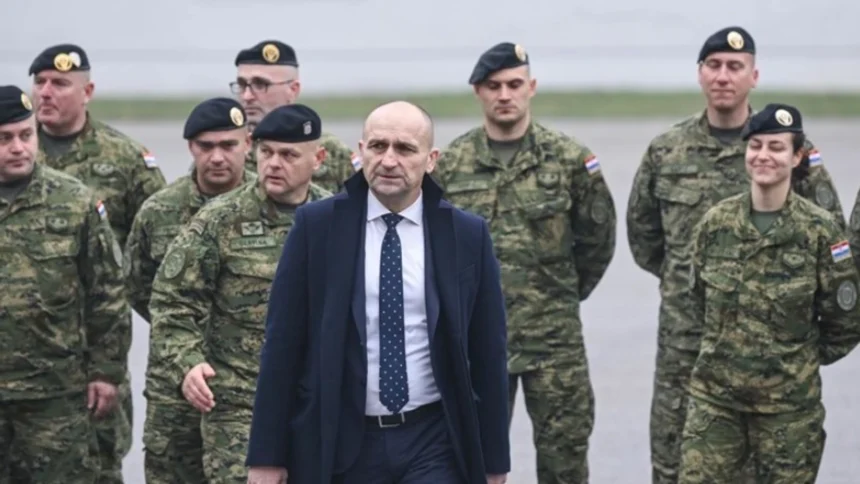
Croatia’s Minister of Defense, Ivan Anušić, has called for heightened preparedness to defend the country’s borders, citing concerns over Serbia’s growing military capabilities. Speaking at a European defense industry conference in Zagreb, Anušić highlighted that Serbia now possesses “serious offensive systems” that are highly sophisticated and have been acquired over the past several years.
“The continuous rhetoric from countries bordering Croatia is concerning. According to the information we have, Serbia currently has offensive systems that are extremely complex, expensive, and have been in the procurement process for four to six years,” Anušić stated.
He stressed that the issue is not only about Serbia, but about broader regional security, noting that the only non-EU, non-NATO neighbors of Croatia are Serbia and Bosnia and Herzegovina. Anušić pointed out that Belgrade continues to pursue weapons acquisitions that could pose serious risks if deployed, signaling ongoing military modernization efforts.
The minister also referenced Serbia’s decision to reintroduce mandatory military conscription, announced by President Aleksandar Vučić in late January, which he interpreted as a response to perceived regional military alliances, including partnerships among Croatia, Albania, and Kosovo.
“We must prepare to defend our borders, our territory, and our people,” Anušić emphasized, underscoring that defense cannot rely on third-party protection alone.
Anušić criticized Europe’s long-standing underinvestment in defense, arguing that priorities have focused on civilian infrastructure, civil society, agriculture, and the economy, rather than military readiness. He called for urgent reforms in European defense strategy, including unified approaches to protecting eastern borders and special funding support for frontline states.
“All countries on the eastern borders of the EU or NATO need special attention in arms and equipment funding, because they could be the next targets. NATO’s readiness to protect its borders may be tested,” he said, citing Baltic states, Finland, Romania, and Croatia itself.
While acknowledging that his warnings may sound “very dark”, Anušić argued that early, candid discussions—similar to those that could have occurred in 2014 during Russia’s annexation of Crimea—might have mitigated some of today’s regional security concerns.
This statement highlights Croatia’s growing unease about Serbia’s military expansion and signals potential tensions in the Western Balkans, as regional powers reassess defense postures amid uncertain security dynamics.