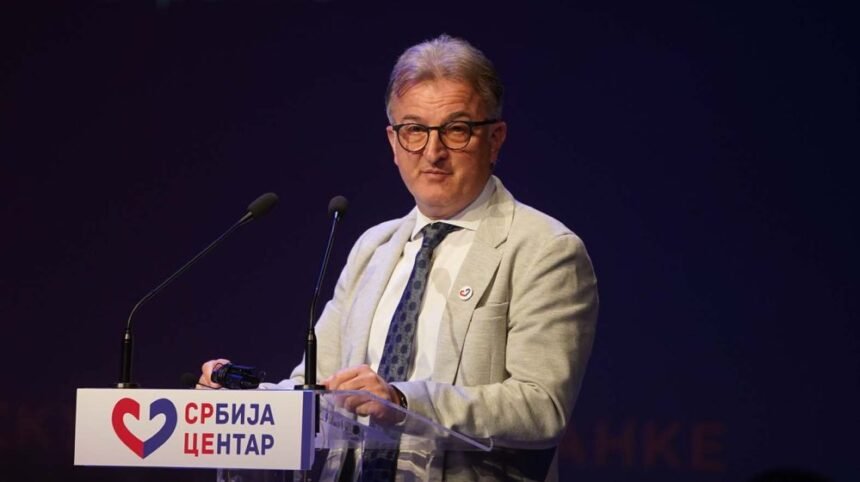
Slobodan Cvejić, Vice President of the Serbia Centre (SRCE) party and a member of the Serbian parliament, stated that representatives of the pro-European opposition informed a delegation of the Council of Europe about what they described as “violence and democratic violations by the ruling regime.”
Speaking after a meeting with representatives of the Council of Europe in the Serbian National Assembly, Cvejić said the discussion focused on key democratic issues affecting Serbia, similar to topics previously raised with officials from the European Parliament and the European Commission.
According to him, the only topic that was not discussed during the meeting was financial assistance or funding, which he described as an indication that the most serious problems in Serbia concern civil rights and democratic freedoms rather than economic matters.
“This clearly shows that the key problems in Serbia lie in citizens’ rights, freedom of expression, media freedoms, and freedom from violence that the ruling regime exercises at every step,” Cvejić said.
He added that representatives of the Council of Europe were interested in hearing specific examples and detailed information about the challenges facing Serbian democracy, in order to determine how they might contribute to improving the situation in the country.
Concerns Over Elections and Institutional Independence
Cvejić also highlighted local elections in the eastern Serbian city of Zaječar, describing them as an example of what he called the ruling government’s control over state institutions.
He said that a recent court decision acknowledging irregularities in the elections indirectly confirmed allegations that the vote had been manipulated.
However, according to Cvejić, the process of repeating the elections has been obstructed by the executive branch, specifically accusing Minister Snežana Paunović and the Ministry of Public Administration and Local Self-Government of blocking the process.
“It is almost certain that the ruling Serbian Progressive Party (SNS) would lose the elections in this larger city in eastern Serbia, which is why the process is being delayed,” he said.
Pressure on Universities and Institutions
Cvejić further warned that state institutions in Serbia are increasingly under political control, arguing that the country’s democratic framework is weakening.
He also claimed that government pressure is being exerted on public universities, which he described as centers of civic activism and democratic movements in the country.
“Wherever there has been a stronghold of the freedom movement in Serbia, pressure is now being applied to suppress any challenge to the current government,” Cvejić stated.
Expectations from the Council of Europe
Despite the concerns, Cvejić said he expects the Council of Europe to take concrete steps to address democratic challenges in Serbia, though he acknowledged that the organization’s ability to act will depend on how much the Serbian authorities allow international oversight.
He concluded by expressing hope that international institutions and domestic opposition forces can work together to strengthen democratic standards and the rule of law in Serbia.