The European Union (EU) Special Envoy for the Belgrade-Prishtina dialogue, Peter Sorensen, visited Kosovo and Serbia this week, yet left both sides with little progress, reflecting a broader stalemate in normalization efforts.
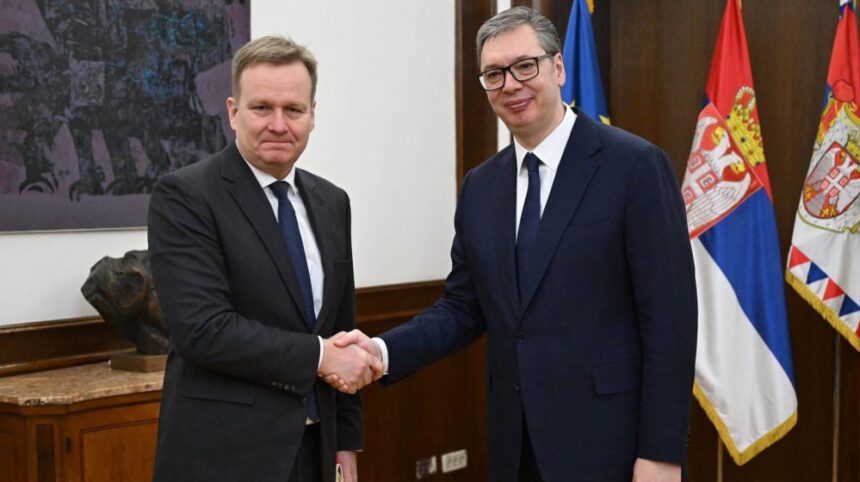
Sorensen’s visit, his second to Belgrade this year following the extension of his mandate, included talks with Aleksandar Vučić on the implementation of Kosovo’s Law on Foreigners, Kosovo’s military cooperation with Croatia and Albania, and the formation of the Community of Serb Municipalities (ZSO). Vučić stressed the need for “concrete steps” toward establishing the ZSO and expressed concern over measures he described as “discriminatory” against the Serb community in Kosovo.
In Prishtina, Sorensen met with Kosovo’s Foreign Minister and head of the negotiation team Glauk Konjufca, Prime Minister Albin Kurti, and President Vjosa Osmani. Discussions focused on enhancing normalization, implementing commitments, and promoting stability and progress along Kosovo’s European path.
However, local analysts remain skeptical. Milija Biševac, President of the Serbian National Movement and municipal councillor in Zubin Potok, emphasized that “dialogue has effectively not existed for a long time.” He cited continuous unilateral actions by Prishtina and inconsistent international responses as major obstacles. Biševac noted that while some topics, such as working groups on missing persons, are discussed, they rarely result in tangible outcomes.
Similarly, Milica Andrić Rakić from the NGO Nova društvena inicijativa highlighted that Belgrade-Prishtina relations are at their lowest since the start of the dialogue in 2011, with the position of the Serb community in Kosovo worsening. She stressed that EU prospects for Kosovo remain blocked, Serbia’s EU path is slowing toward potential stagnation, and Kosovo unilaterally determines the status of the Serb community.
The consensus among observers is clear: without the cessation of unilateral actions, consistent respect for existing agreements, and a more active, impartial role from international mediators, the dialogue risks being reduced to a series of procedural meetings with little real impact.