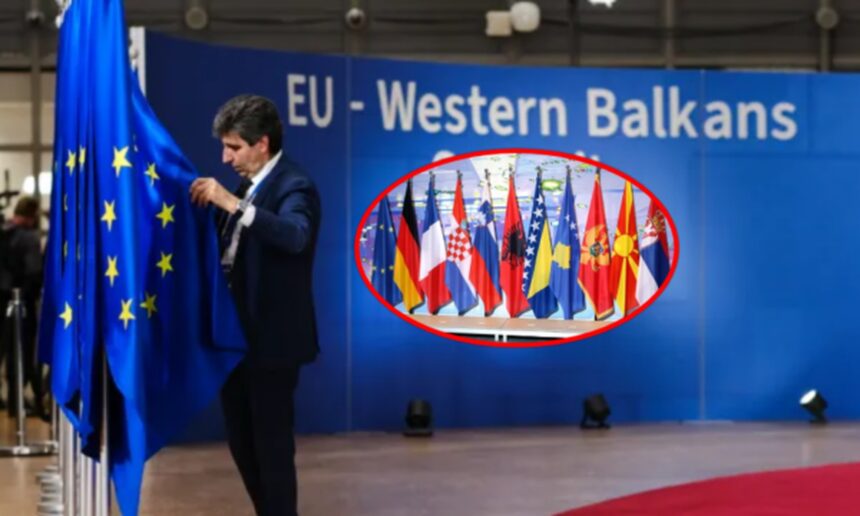
Recently, Brussels has signaled the potential opening of EU membership talks for several Western Balkan countries—something that has not happened since 2013, when Croatia received the green light to join the EU. While nothing is certain yet, the years 2027 and 2029 have been mentioned as possible dates for new accessions. One of the key European figures to speak on this issue is German Chancellor Friedrich Merz. Speaking at the Munich Security Conference, Merz expressed dissatisfaction with the approach of European states toward the Western Balkans, according to Rks News.
Merz also emphasized that the countries of the region are part of the European continent and expressed the desire to open as many chapters as possible for these countries to move closer to the EU.
Meanwhile, Western Balkan countries eager for EU membership have recently shown a willingness to reach consensus, potentially facilitating their accession.
The first to openly support a special EU membership arrangement was Albanian Prime Minister Edi Rama.
A few months ago, Rama proposed the idea of EU membership without the right to veto—a position he said he has held for some time. According to Rama, “a veto is not necessary.”
“There are many within the EU who cause trouble and say no. They have veto rights. For a long time, I have said that we are willing to be members even under a different status, without the right to veto and vote, as long as the EU reforms itself—a process that seems very difficult,” Rama stated, according to Express.
The Albanian Prime Minister, whose country is closest to EU membership among the regional states, added that the goal is to “be stronger together” with the EU.
“We want to be stronger together, and to achieve this, we are ready to give up things you see as complicated. Therefore, we do not need a veto, we will never vote against the majority, and we do not need our own commissioner,” Rama said.
Recently, Serbian President Aleksandar Vučić reportedly joined Rama’s idea. According to German journalist Michael Martens of the prestigious newspaper FAZ, Vučić has sent a “message” that Serbia would even be willing to forgo its veto right—traditionally granted to every EU member state—in exchange for (currently hypothetical) EU membership.
“The President of Serbia, Vučić, on the front page of FAZ—this hasn’t happened in a long time. His message: Serbia would even be ready to give up the veto right permanently, which usually belongs to every EU member, in exchange for membership (currently hypothetical) in the EU. More soon,” Martens wrote.
Regarding this idea, North Macedonian Prime Minister Hristijan Mickoski also commented.
He stated that EU membership is possible even without voting rights. According to Mickoski, this could happen as early as 2027, as part of a scenario connected to the peace plan for Ukraine.
“There is an idea increasingly heard in Brussels and elsewhere, which involves the peace plan for Ukraine, in which Ukraine’s integration—and its future reconstruction within the EU—would follow an accelerated path. This would be disproportionate to the Western Balkans and presents two scenarios. We are fortunate to be part of both. The first scenario is that Ukraine, together with Montenegro, Albania, and North Macedonia, becomes EU members, and by early 2027, the Macedonian flag would be raised in Brussels—but without voting rights. Participation would include council work, committees, institutions, and internal oversight mechanisms. This integration would occur in 2027. The second condition is that other regional countries—Bosnia and Herzegovina, Serbia, Kosovo, and Moldova—would join this process,” Mickoski stated in Samo Intervju on Kanal5.
Unlike these three countries, Kosovo has not commented publicly on the idea. Rks News sought a response from the Kosovar government but received no official statement.
However, Kreshnik Ahmeti, Kosovo’s Deputy Minister of Foreign Affairs and Diaspora, told Radio Free Europe that the government would consider the idea if “this hypothetical scenario materializes.”
“The MFA does not comment on potential closed-door discussions within EU institutions. Should this hypothetical scenario materialize, we will review it in due course. For now, what is important for Kosovo is to begin the official integration process by obtaining candidate status and completing the questionnaire,” Ahmeti told Radio Free Europe.
Kosovo, which recently formed a new government after more than a year and following months of political deadlock, now faces another potential political impasse: the election of the president, which must take place by March 4.
Thus, Kosovo’s foreign policy under the responsibility of both the president and the Ministry of Foreign Affairs is currently split: on one hand, Vjosa Osmani, who appears to be in her final days in office, and on the other, Glauk Konjufca, who has just assumed his new responsibilities.