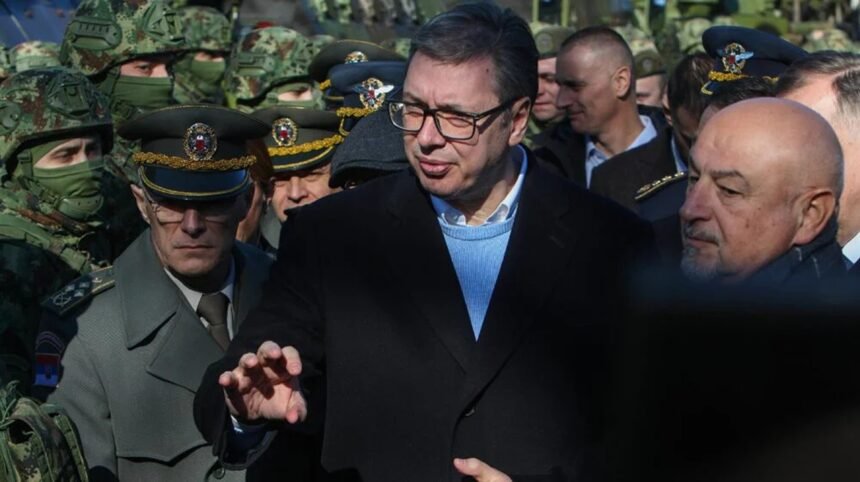
Serbia’s Government has taken yet another step toward converting the country’s political system from a parliamentary democracy into a one-man show. In an extraordinary session on November 20, the Government adopted amendments to the Law on the Serbian Armed Forces that would officially place the entire military under the direct command of President Aleksandar Vučić.
Yes in a parliamentary system, the president is about to become the Commander-in-Chief.
If it sounds unconstitutional, that’s because it is.
Under the current law, the Army is commanded by the Chief of the General Staff and senior officers, based strictly on professional military procedures. But with the proposed changes, the Chief of the General Staff will be legally obligated to obey the decisions of the President transforming the military’s top officer into little more than an executor of presidential orders.
The Government insists this centralization is needed for “efficiency” and claims the change must be adopted urgently to avoid “harmful consequences.” No specifics, of course just the usual vague warnings that conveniently justify rushing through controversial moves.
Experts: Vučić Is Seizing Powers That Don’t Belong to Him
Retired General Momir Stojanović calls the proposal “absurd, unconstitutional, and dangerous,” noting that Serbia is not, and never has been, a presidential republic.
“In our system, power lies with the Government. Even in wartime, the Government—not the President—holds supreme command,” Stojanović explains, adding that Serbia’s military tradition since 1945 has never recognized the office of Commander-in-Chief.
Yet Vučić has long been styled as “Supreme Commander” by his loyalists and state media, despite having no legal basis for such a title. Now, the law is being rewritten to make the nickname a formal reality.
According to Stojanović, if the amendments pass, the president will gain the unprecedented ability to deploy the Serbian Army without the Government’s approval—an extraordinary concentration of power that contradicts every principle of a parliamentary democracy.
A Civilian Commander With No Military Credentials
Former Defense Ministry spokesperson Petar Bošković traces the origins of this theatrical militarization back to Aleksandar Vulin, who ordered Vučić’s portraits to be hung in barracks and coined the now-popular “Commander-in-Chief” title to flatter his political patron.
Bošković stresses that leadership and command are among the most complex subjects studied by officers at the Military Academy—skills that require experience, education, and professional training.
“Now Aleksandar Vučić will be able to directly order the Chief of the General Staff how many tanks to deploy, how many aircraft to move, and when,” Bošković says. “It is literally heresy for a civilian to direct military operations.”
With cutting irony, he adds:
“At this rate, the only thing left is for him to take over the church.”
Urgency Without Cause, Power Without Limit
Critics are baffled by the Government’s insistence on adopting the amendments through an urgent procedure. Serbia is not under attack. There is no imminent war. No crisis. No natural disaster. Nothing.
What is urgent, however, is Aleksandar Vučić’s desire to tighten his grip over every remaining institution. The police, intelligence services, courts, prosecution, media, and special units are already deeply aligned with the executive. The military was the last relatively autonomous structure.
Not anymore.
A President Who Wants to Be Everything
The proposed amendments do not simply shift administrative roles—they fundamentally reshape Serbia’s constitutional order. By placing the military under direct presidential control, Vučić is extending his authority far beyond what the Constitution allows.
If the law passes, Serbia will inch closer to a model where one man commands the government, the security apparatus, the judiciary, and now the military.
In other words, Vučić is no longer behaving like a president of a parliamentary republic—
but like a leader preparing for unchecked personal rule.
After this, indeed, only the church remains.