The German government is reorganizing its partnerships: from new alliances with Italy and India to strategic partnerships with Gulf states.
Recent intensive diplomatic and economic activities recall the period after the start of the war in Ukraine, when Russian gas supplies were cut off and Berlin had to seek new partners. Now, the alliance with the U.S. is “under pressure,” following the U.S.’s announcement of its new strategy toward Europe. Not only Germany, but also other medium Western powers, such as Canada, are seeking partners worldwide.
Chancellor Friedrich Merz visited Saudi Arabia, Qatar, and the United Arab Emirates this week. Foreign Minister Johann Wadephul is completing visits in Asia-Pacific countries (Australia, New Zealand, Singapore, Tonga, Brunei).
“We need such partnerships… in a world where major powers dominate politics,” Merz explained to the media in Riyadh. He added that this is the best way to safeguard freedom, security, and prosperity.
Wadephul was even more direct: “There is no power vacuum anywhere in the world; it is filled by those who are present,” he said on ZDF TV.
Gulf States: Economic Interests and Discussions
Germany’s intensified cooperation with Gulf countries—some of which have controversial human rights records—raised questions in German media. Merz stated that he addressed human rights in all meetings with Gulf states, but “I do this behind closed doors.”
Trade cooperation between Germany and Gulf states is based on mutual interests. While Saudi Arabia seeks to modernize its structures, Berlin is working on renewing Germany’s economy. The wealthy Gulf monarchies are ready to spend hundreds of billions of dollars on modernization. Saudis are particularly interested in German technology, including construction engineering, underground works, and German arms. Wadephul stated, “Many states want to cooperate with us.”
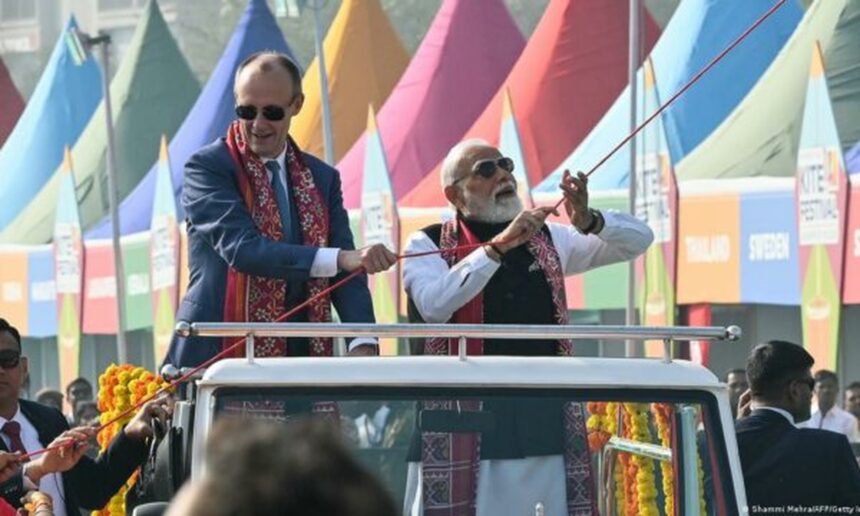
Earlier (Jan 12–13), Chancellor Merz was warmly received in India, where he signed 19 economic agreements, including a €1.24 billion partnership for renewable energy and joint naval and air exercises.
Ten German Ministers in Rome: Merz and Meloni Build Consensus
Merz’s visit to Rome (Jan 23, 2026) with Italian Prime Minister Giorgia Meloni stood out. Merz was accompanied by ten German ministers—half of the cabinet. Germany and Italy clearly expressed aligned views on nearly all European future policies.
Both sides agreed in a document to strengthen coordination on European issues, curb illegal immigration, increase repatriations, and implement more joint defense projects. Correspondents noted a close personal rapport between Merz and Meloni. Meloni is politically stable, unlike Emmanuel Macron. Both share similar positions on some of President Trump’s policies, as reflected in their statements on the Peace Board. They also align on Ukraine and global trade.
Faded Enthusiasm Between Berlin and Paris
Germany-France cooperation has experienced changes since May 2025, when Merz came to power. Consolidating the partnership with France was a primary goal. By August, twenty “core projects” were finalized, but initial optimism has gradually weakened.
Some experts see the Merz-Meloni partnership as central for intensifying cooperation, noting that the Mercosur trade agreement with South American countries was only approved by the EU thanks to Italian support. France opposed it, despite 25 years of EU negotiations.
Berlin is frustrated with France’s blocking stance on the joint future fighter aircraft project, which risks collapse. Friction also exists regarding Ukraine. Macron’s initiative to invite Russian President Putin to Paris without coordinating with Berlin (publicized by Trump) was unexpected.
Berlin Consolidates Power
France remains a major European military power. However, Berlin is intensively building the largest conventional army in Europe. In late January, Germany officially prioritized developing a national satellite-based missile detection system for greater independence. Meanwhile, France faces crushing debt that limits its options. Analysts note that Merz is very active internationally, making it structurally difficult for Paris to compete as Berlin consolidates its position as a dominant political player.