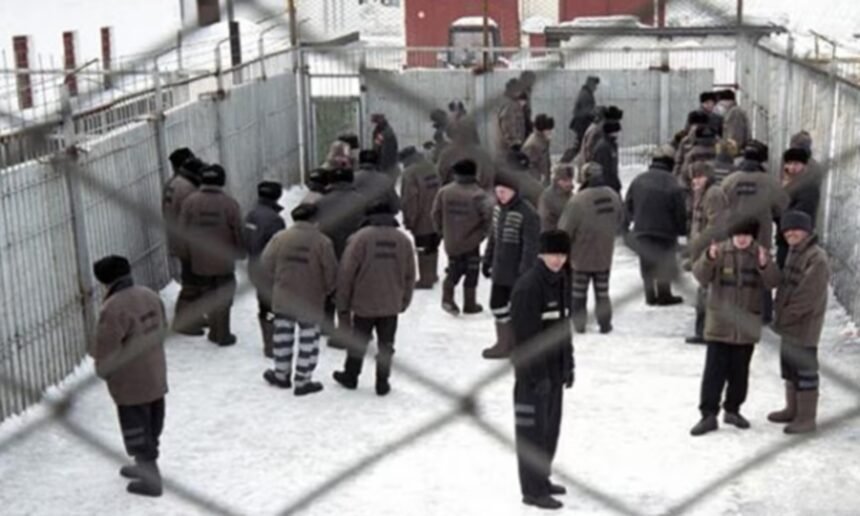
Like many other Ukrainian soldiers held at Correctional Facility No. 10 (IK-10) in Mordovia, Russia, Pavlo Afisov recounted horrific physical and psychological abuse. Upon arrival, he was beaten severely, and over more than 18 months in captivity, he was forced to crawl on the cell floor while dogs were set on him and nearly died when guards shoved his head into a garbage bag.
“It’s terrifying and horrible because in that moment you lose all connection to the outside world and start to suffocate. You try to remove the bag with your hands, but they hit you and shock you with an electric taser,” Afisov, a naval infantry officer captured during the Russian siege of Mariupol in 2022, told the Ukrainian Service of Radio Free Europe/Radio Liberty (RFE/RL). He returned home through a prisoner exchange in 2024.
He was sent to the prison doctor, hoping for relief.
“Until then, I thought it couldn’t get worse,” Afisov said, 26. “But when they took me there… I don’t even know, you can’t call it human. He started shaking a taser and shocked me several times. He threatened me, saying, ‘Come on, quickly, don’t act stupid.’ He spoke very loudly, pretending to be a great commander, calling us ‘kutërbon khokhly’—a derogatory term for Ukrainians—saying we didn’t deserve decent treatment.”
Another marine, Oleksandr Savov, who spent six months at IK-10, was similarly shocked when he encountered the same doctor.
“He stopped in front of me, I saw he was wearing a white coat. I thought, ‘He’s a doctor,’” Savov said. “I told him I suspected I had tuberculosis. He said, ‘Why are you shouting?’ I didn’t understand—it was my first time there. Then he shocked me with a taser! Be quiet. Again, he said, ‘Why are you shouting?’ and shocked me again.”
Savov, who suffered from tuberculosis, skin disease, and lymphedema, died on November 16, 2025, after being returned to Ukraine in March through a prisoner exchange.
Identification of “Doctor Soulcrusher”
Through an award-winning investigation by Schemes—RFE/RL’s investigative unit—together with the Organized Crime and Corruption Reporting Project (OCCRP), the doctor was identified as Ilya Sorokin, whose actions left lasting trauma among prisoners.
The EU imposed sanctions on Sorokin in October 2025 for “inhuman and degrading treatment” of prisoners of war, including physical violence and electric shocks.
Schemes verified Sorokin’s identity through prison service records, photos, and video footage, and by interviewing nearly 150 Ukrainian former detainees at IK-10. Some recognized him immediately, others confirmed him by voice, recalling the man they knew as “Doctor Soulcrusher.”
“He would derive aesthetic pleasure from seeing you on all fours, hands up, eyes closed, helpless. Then… he would strike you in the groin, under the stomach, in the liver, shock you with a taser,” Afisov recalled. “He said people like us ‘must face genocide.’”
Survivors described systematic abuse: standing from 6 a.m. to 10 p.m., beatings with sticks, hammers, and plastic tubes, sexual violence, and mock executions. Sorokin’s cruelty stood out particularly because he was a medical professional.
Former prisoners described his behavior as incomprehensible. He would deny medical aid and use his position to torture detainees, giving only superficial attention when required.
Death in Mordovia
Valentin Polyanskiy, a naval infantry officer, described the deteriorating condition of his cellmate, Volodymyr Yukhymenko, who suffered severe mental and physical abuse. Guards beat him to the point where his ear canal was completely detached. He was later tied to a bed and denied medical care, dying in captivity. DNA tests later confirmed his identity with 99.99% certainty.
The accounts of survivors illustrate a systematic pattern of torture, abuse, and dehumanization within Russian detention facilities, leaving deep physical and psychological scars on Ukrainian soldiers.