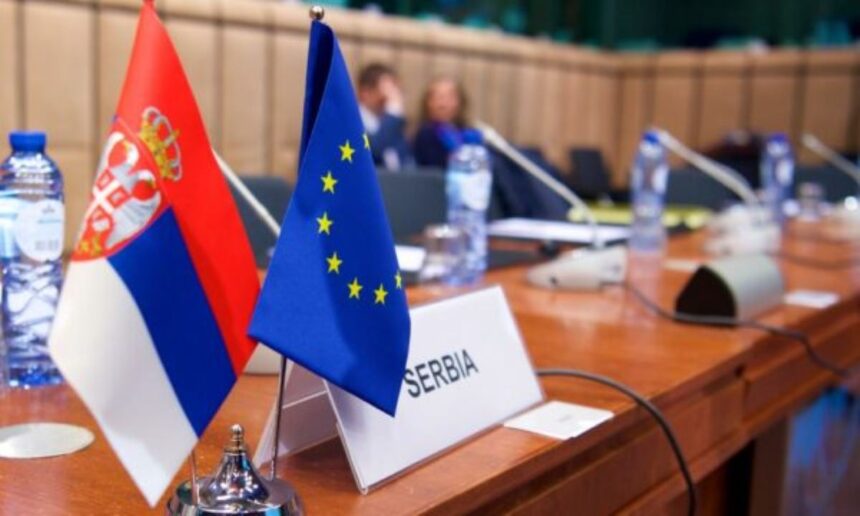
The European Union (EU) has advised Serbia to make clear strategic choices on its European path, following Belgrade’s purchase of supersonic CM-400 ballistic missiles from China.
A spokesperson for the European Commission stated that:
“This includes avoiding strategic dependencies that are not compatible with this goal.”
The spokesperson added:
“A credible European path implies a commitment to regional stability and a shared understanding of the security challenges facing our continent.”
On Thursday, Serbian President Aleksandar Vučić confirmed that his country had acquired the CM-400 missiles, prompting reactions from neighboring states. With this acquisition, Serbia became the first European country—after Pakistan—to possess the CM-400, according to international arms registers. Serbia is surrounded by NATO member states.
NATO declined to comment to Radio Free Europe/Radio Liberty regarding Serbia’s new armaments.
Meanwhile, Croatian Prime Minister Andrej Plenković, whose country is a NATO member, announced plans to inform other NATO partners:
“We will discuss with our partners in the North Atlantic Alliance and alert them to this type of armament, which is new to Serbia’s military arsenal,” Plenković said.
On the other hand, Kosovo’s Defense Minister, Ejup Maqedonci, told Radio Free Europe/Radio Liberty that Serbia’s claims of arming for self-defense against neighbors are unfounded. He argued that Serbia’s purchases of Russian and Chinese weapons demonstrate hegemonic ambitions, not a response to any actual threat:
“No neighboring state has shown any aggressive intent toward Serbia. Serbia is the one asserting territorial claims against Kosovo.”
According to the Stockholm International Peace Research Institute (SIPRI), between 2020 and 2024, Serbia imported the majority of its weapons from China (57%), followed by Russia (20%) and France (7.4%).
Serbia’s recent acquisitions have prompted criticism from Plenković, who plans to raise the issue within NATO. Responding, Vučić stated:
“Zagreb will not decide what Serbia possesses.”
He further claimed that Serbia is preparing for a potential attack from an alliance formed by Pristina, Tirana, and Zagreb. In March 2025, Croatia, Albania, and Kosovo signed a Defense and Security Cooperation Declaration, which Serbian officials consider a threat to Serbia’s security.