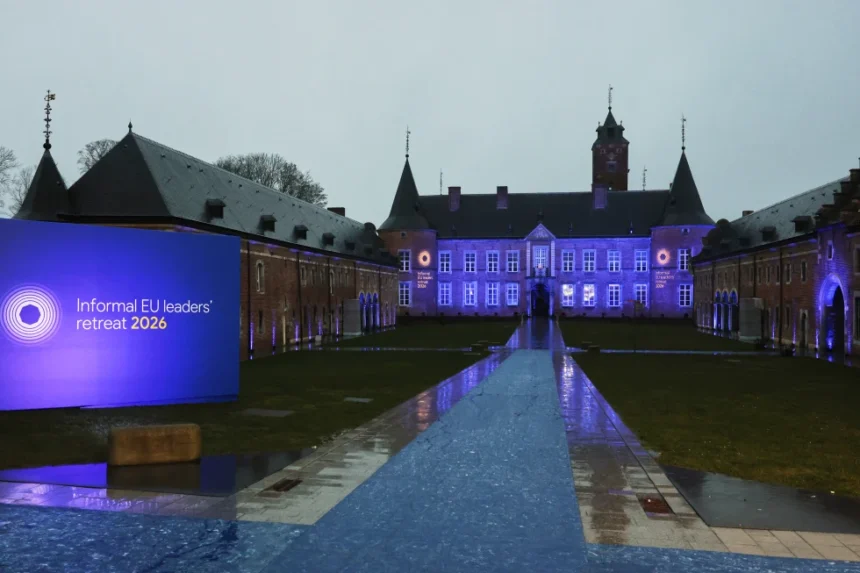
Leaders from the 27-member European Union convened Thursday at the 16th-century Alden Biesen Castle in Belgium to discuss strategies for safeguarding the bloc amid growing global pressures from U.S. President Donald Trump, China’s economic assertiveness, and Russia’s hybrid threats.
The summit comes at a critical juncture as Europe faces a series of challenges that have prompted a rethink of its approach to diplomacy, defense, and trade. Belgian Prime Minister Bart De Wever noted that while the bloc understands the direction it must take, achieving decisive action remains difficult.
Competing Visions for Europe’s Future
Key EU leaders are divided over the bloc’s strategic path:
- German Chancellor Friedrich Merz and Italian Prime Minister Giorgia Meloni advocate deregulation, deeper economic integration, and broader trade deals, citing the recent Mercosur agreement as a model for revitalizing EU trade relations.
- French President Emmanuel Macron emphasizes “European preference” in strategic sectors such as cleantech, chemicals, steel, automobiles, and defense to protect the bloc against unfair global competition from China and the U.S.
Macron warned that without stronger European industrial protections, “Europeans will be swept aside,” underscoring the importance of defending strategic sectors in an increasingly unbalanced global economy.
Defense Spending and Economic Security
Disagreements also emerged over defense priorities: Macron favors prioritizing EU arms companies, while Merz and Meloni advocate for flexible procurement from both European and foreign suppliers. NATO Secretary General Mark Rutte reinforced the importance of EU defense, noting Europe and Canada are “stepping up and spending billions more on defense”, while praising the U.S. for leading efforts to secure peace in Ukraine.
On the economic front, President of the European Commission Ursula von der Leyen highlighted that Europe’s global influence depends on its economic strength, calling for regulatory simplification, strengthened single market mechanisms, and a unified trade policy.
Financial Instruments to Counter Global Pressures
EU leaders will also debate new financial instruments to protect the bloc against economic shocks, including proposals akin to “Eurobonds for the future”, aimed at challenging the dominance of the U.S. dollar and bolstering European strategic autonomy.
Meanwhile, Merz and Meloni advocate for cutting red tape, investing in infrastructure, and diversifying trade ties, reflecting a vision of economic modernization paired with regulatory integration.
Public Support for Stronger EU Leadership
According to a Eurobarometer poll, European citizens are calling for more ambitious and unified leadership, particularly as the bloc navigates military threats, climate instability, and external economic pressures.
Alberto Alemanno, professor of EU law at HEC Paris, emphasized: “There has never been a better time for European leaders to leverage citizens’ demand for greater European action.”
As EU leaders prepare for a follow-up summit in late March, the divisions between pro-deregulation, open-market advocates and defenders of European strategic autonomy will shape the bloc’s response to the triad of Trump-era U.S. unilateralism, Chinese economic coercion, and Russian hybrid aggression.