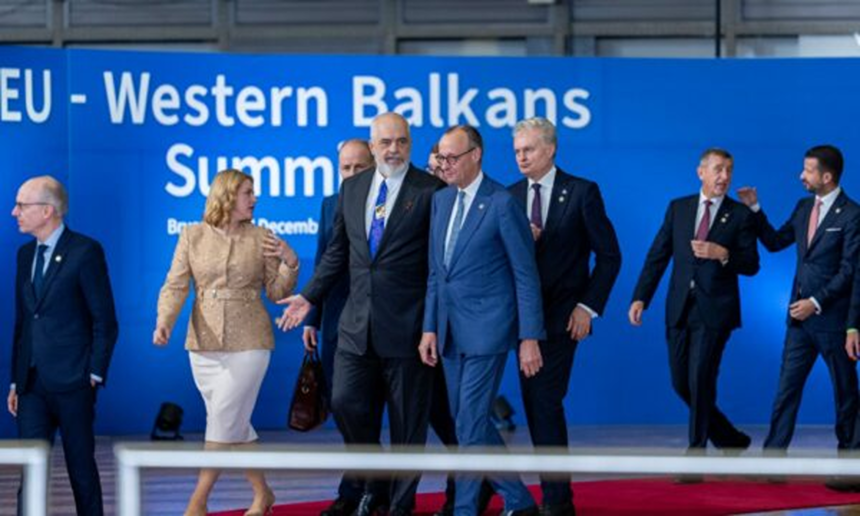
The debate over whether new members of the European Union could join without veto rights is gaining momentum across Europe and the Western Balkans.
After comments from Edi Rama, Aleksandar Vučić, and German Green politician Anton Hofreiter, additional voices have entered the discussion, according to reporting by Michael Martens in Frankfurter Allgemeine Zeitung.
CDU: Time to Move Beyond “All or Nothing”
From Germany’s ruling Christian Democratic Union (CDU), MP David Preisendanz — parliamentary rapporteur for EU enlargement — described the discussion about alternatives to full membership, including membership without veto power, as “moving in the right direction.”
He criticized the current enlargement policy as dysfunctional and argued for a phased approach:
“We must move away from black-and-white thinking and from the logic of ‘inside or outside.’ This either–or approach has kept the Western Balkans at the EU’s doorstep for more than 20 years. Given the influence of Russia and China in the region, this has now become a geopolitical risk.”
Preisendanz suggested gradual integration, starting with access to the EU single market for countries that fulfill key reform criteria. However, he stressed that for Serbia, this issue is not currently on the agenda.
“EU membership — in any form — depends on the consistent fulfillment of core accession criteria,” he said, emphasizing reforms in the rule of law and judicial independence.
He added that Serbia is currently experiencing setbacks in this area and accused Vučić of steering the country away from the EU.
Reactions from the Region
Serbian opposition politician Pavle Grbović echoed a similar view on X, stating that Serbia could join the EU even without veto rights — but not under a government “immersed in crime and corruption, suffocating the media and destroying the judiciary.”
Meanwhile, Elmedin Konaković, Foreign Minister of Bosnia and Herzegovina, described the idea of joining without veto rights as “phenomenal,” arguing it would attract investment, raise wages, and help keep young people in the country.
Former Bosnian Foreign Minister Igor Crnadak also called phased enlargement without veto rights “an excellent idea,” saying it demonstrates creativity and determination to move the enlargement process forward.
Macron’s Longstanding Warning
Emmanuel Macron has for years warned that admitting new member states with veto rights could paralyze EU decision-making. The proposal to limit veto powers aims to address concerns among existing member states about institutional gridlock.
However, Hristijan Mickoski, Prime Minister of North Macedonia, said his government has never officially received such a proposal and declined to comment prematurely. He nevertheless noted that his country has waited too long at the EU’s doors despite meeting many criteria.
Clarifying the Concepts
Martens concludes by noting that public debate often confuses three distinct ideas:
- Full EU membership without veto rights
- Membership only in the EU single market
- Gradual or phased integration
Importantly, access to the EU single market is not merely a free-trade arrangement. Countries must fully meet the Copenhagen criteria — including democratic stability, rule of law, human rights, and minority protections — not just economic benchmarks.
“Without fulfilling the political criteria, access to the single market is impossible. That is why Norway can participate, while Belarus could not — even if it wanted to,” Martens writes.
Whether Western Balkan states can meet these conditions — and whether existing EU members would accept such alternatives — remains uncertain.
One thing, however, is clear: the current enlargement process, effectively stalled since 2013, has reached a dead end.