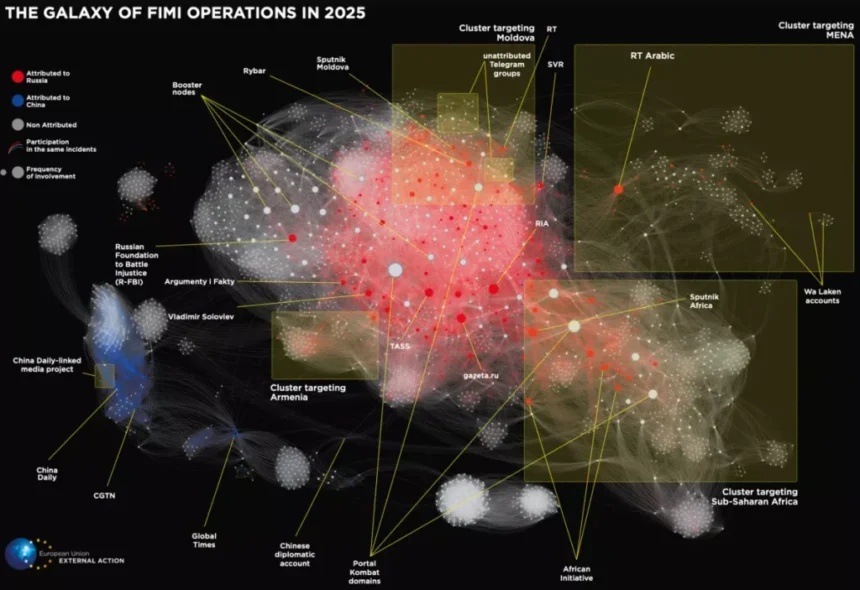
Manipulation and Foreign Information Interference (FIMI) has evolved into a dense, interconnected ecosystem of actors, infrastructure, and narratives operating across digital platforms and geopolitical contexts.
The concept of the “FIMI Galaxy,” outlined in the European External Action Service’s (EEAS) recently published 4th report on FIMI threats, captures this systemic reality. It exposes the complex architecture behind influence operations and provides a strategic tool to understand and counter them.
Mapping the Architecture of Information Manipulation
Compared to previous assessments, the 2025 landscape appears more active and dense. The number of identified FIMI incidents and operational channels has increased, and the resilience with which threat actors reuse their assets across campaigns and geographic areas has become more evident.
This reflects the growing sophistication of the FIMI ecosystem, where manipulation increasingly functions as an organized, industrialized activity, often supported by specialized services. The integration of artificial intelligence tools has accelerated the production and distribution of manipulative content at scale and reduced costs.
Another key development is the expansion of the frontlines in the information space. Almost every major geopolitical event now has a parallel FIMI dimension. Narratives tied to conflicts, elections, or geopolitical tensions circulate simultaneously across regions and languages, creating constant informational pressure aimed at shaping public perception and discourse.
The FIMI Galaxy serves as an interactive tool to visualize and expose the networks behind these operations. It is structured around three analytical layers:
- Threat Actors: This includes Russia, China, and numerous unattributed networks. Many of the most active assets cannot be directly attributed to a single state actor, reflecting the use of proxies, intermediaries, and covert networks designed to obscure accountability.
- Information Manipulation Sets (IMS): An IMS is a “digital fingerprint” of a continuous manipulation infrastructure. These sets link channels, tactics, and infrastructure likely connected to the same actor or operational ecosystem. IMS mapping helps identify reused infrastructure and techniques, highlighting convergence across FIMI operations (e.g., the “Portal Kombat” network).
- Targets: FIMI campaigns aim at specific countries, organizations, or individuals. By linking IMS channels to their objectives, the Galaxy reveals strategic goals behind manipulative operations.
Within the Galaxy, different groups illustrate targeting strategies: some aim at international audiences, while others focus on specific regions, including Eastern Neighborhood countries, the Middle East and North Africa (MENA), and Sub-Saharan Africa. Assets can be redeployed across geopolitical contexts—after Moldova’s elections, similar networks targeted Armenia ahead of its parliamentary vote.
These campaigns follow familiar patterns: networks of fake accounts, fabricated investigations, media imitation, and coordinated amplification. They systematically seek to discredit political leaders, amplify polarizing narratives during election periods, and undermine trust in the electoral process.
Current mapping visualizes roughly 3,000 active channels and their interconnections, representing a fraction of the broader ecosystem but demonstrating the scale and complexity of the network. Notably, around 90% of these channels belong to a hidden ecosystem, meaning they cannot be directly identified as state-controlled assets linked to Russia or China.
FIMI Galaxy 2025 is, above all, a call to action. Understanding its architecture is essential for strengthening prevention, building resilience, and protecting the integrity of the information environment.
Illustrative Cases:
- Pro-Kremlin Narratives on Energy: Russian FIMI-linked media portrayed Russia as essential for European stability, arguing that sanctions harm Europe more than Russia, using energy crises tied to Iran to depict Europe as facing decline while advocating for the lifting of sanctions.
- Destabilization of Ukraine: Pro-Kremlin channels claimed Ukraine was sending saboteurs to Qatar, Saudi Arabia, and the UAE under the guise of air defense experts, aiming to undermine trust in Ukraine’s international partnerships and its role in counter-drone capabilities in the Gulf region.
By visualizing these networks and tactics, the FIMI Galaxy highlights the urgent need for coordinated measures to counter foreign influence and protect democratic discourse globally.