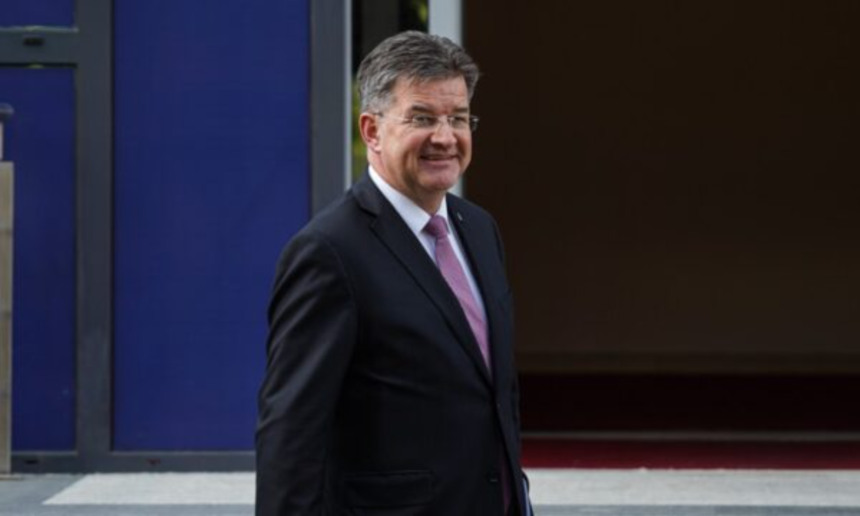
The involvement of former EU Special Representative for the Kosovo–Serbia dialogue, Miroslav Lajčák, in the Epstein files has not compromised the normalization process between Kosovo and Serbia, European officials insist.
According to the European Union, the publication of messages exchanged between Lajčák and convicted sexual abuser Jeffrey Epstein did not damage the dialogue process, which Lajčák mediated for five years.
EU spokesperson Anitta Hipper stated that the dialogue remains under constant supervision by EU member states, emphasizing that individual controversies do not alter the framework of the process.
“As far as the dialogue itself is concerned, it remains unaffected by such developments. The dialogue has been a stable process since 2011, owned by the parties and led by the High Representative. It is also continuously supervised by the member states,” Hipper said.
During today’s press conference, EU spokespersons were asked whether the Slovak diplomat had been subject to ‘external influence’, following revelations from 2018 communications in which Lajčák discussed a possible meeting with Russian Foreign Minister Sergey Lavrov, whom he described at the time as a “professional role model.”
In his first public statement on the matter after resigning as adviser to Slovak Prime Minister Robert Fico, Lajčák said that his views changed after Russia launched its full-scale invasion of Ukraine.
“I changed my view of Lavrov once he became the face and voice of the aggressor in Ukraine,” Lajčák told a Slovak radio station.
Despite the controversy, EU officials maintain that the Kosovo–Serbia dialogue remains institutionally safeguarded and politically insulated from personal affiliations or past contacts of individual mediators.