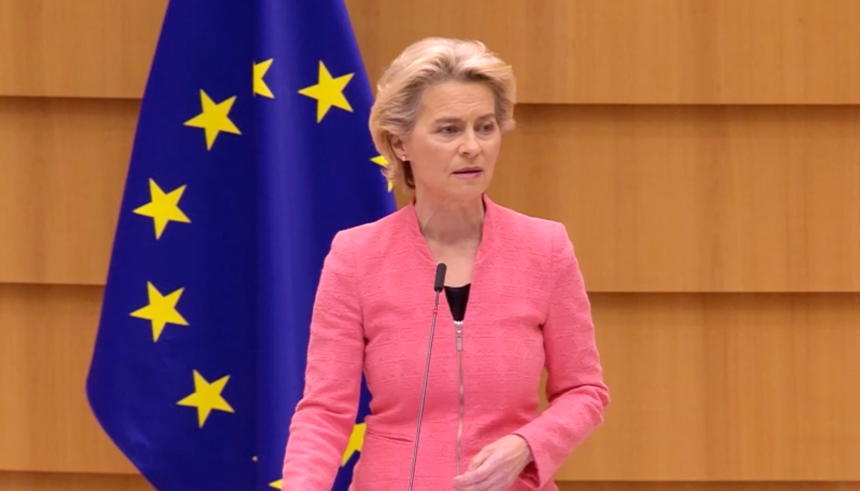
The European Commission announced on Wednesday the presentation of a €90 billion loan package for Ukraine, as Brussels steps up efforts to support Kyiv in its fight against increasingly intense Russian attacks and amid U.S.-led initiatives aimed at ending the war.
Two-thirds of the fund will be allocated to military assistance for Ukraine, including the purchase of weapons and ammunition, even from outside the European Union, according to Commission President Ursula von der Leyen. The remaining €30 billion will be used to cover Ukraine’s expected budget shortfall.
According to the Commission, Ukraine will require €135.7 billion in military and budgetary support in 2026 and 2027, including €52.3 billion in fiscal support and €83.4 billion in military aid. The Commission also warned that Kyiv is expected to run out of funds by April.
“With this support, we ensure that Ukraine can, on the one hand, strengthen its defense on the battlefield and its defensive capabilities—covering all military needs—and, on the other hand, maintain the functioning of the state and basic services,” von der Leyen told reporters.
She added that military support would follow a “cascade principle,” meaning Ukraine would only purchase weapons from outside the EU if suitable European military equipment is unavailable.
“European preference first, and if that is not possible, then purchases from outside,” she stated.
France has long advocated for a “European preference” in military procurement. However, Germany and several Eastern European EU member states argue that the bloc should remain open to purchasing defense equipment from Washington, despite declining U.S. support for Kyiv and recent tensions following U.S. President Donald Trump’s threats to seize Greenland, a semi-autonomous Danish territory.
The loan will operate under a mechanism of “enhanced cooperation” among EU member states, allowing Hungary, Czechia, and Slovakia to opt out. These three countries are strongly skeptical of providing financial assistance to Kyiv.
A senior Commission official said the loan—backed by the EU’s long-term budget—would cost member states approximately €3–4 billion annually in interest payments. The proposal also follows last year’s failure by the Commission and Germany to persuade Belgium to support a “reparations loan” using frozen Russian sovereign assets. Belgium holds the vast majority of the €185 billion in Russian funds frozen by the EU following Moscow’s full-scale invasion of Ukraine in 2022.
However, von der Leyen said the reparations loan “remains on the table.”
“It is very important to send Russia a strong reminder that we reserve the right to use frozen Russian assets,” she said, adding that these assets will remain frozen until the war ends and that Ukraine would only repay the loan after Moscow pays reparations to Kyiv.
Meanwhile, Ukrainian President Volodymyr Zelensky said on social media that the latest Russian barrage—including 113 attack drones and three ballistic missiles—underscored the urgent need to strengthen Ukraine’s fighters now.
The loan package must still be approved by the European Parliament and EU member states. The Commission aims for the first disbursement by April, von der Leyen said.