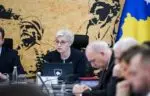
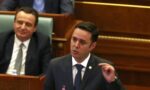
The European Integration Committee has approved the review of the Draft Law on the ratification of the “Agreement between the Republic of Kosovo and the European Union on arrangements for implementing EU support for Kosovo under the Instrument for Reforms and Growth.”
Finance Minister Hekuran Murati presented the agreement to the committee members, stating that under this instrument, Kosovo is expected to receive a total of €882.16 million.
“I am pleased to present today to you, in principle to the Committee for ratification in the Assembly of the Republic of Kosovo, one of the two instruments — the agreement concerning the reform agenda, the reform package itself. One instrument, the one being approved today, is the reform package; the second instrument concerns financing, the credit part, which will be approved later by the Budget Committee in a separate agreement. This is the agreement on the reform component of the Growth Plan.
The advantage of this agreement, as the Chairperson also noted, is that besides financial support, it includes the approval of various reforms agreed with the European Union. Furthermore, these reforms aim to accelerate Kosovo’s convergence toward EU standards. In financial terms, Kosovo will be the largest beneficiary relative to its GDP — around 10% of the country’s gross domestic product — of the support package under the Growth Plan. From the instrument for reforms and growth, Kosovo is expected to receive €882.16 million, of which €253.3 million are grants (approximately one-third), while the remaining €629.3 million will be provided as loans, which will be ratified under a separate agreement,” Murati explained.
Murati emphasized that Kosovo was among the first countries to finalize its reform agenda, achieving this within the initial deadline set by the European Commission, with formal approval in October 2024.
“The purpose of the framework agreement, whose text is standardized for all beneficiary states, is to establish the general contractual basis enabling Kosovo to benefit from EU funds under the Instrument for Reforms and Growth. Meanwhile, the credit agreement specifically regulates the conditions related to the EU funds provided as loans and their management. During the previous government mandate, we prioritized this instrument to meet all deadlines set by the European Commission.
As a result, Kosovo was among the first — if not the very first — to finalize the reform agenda within the initial timeline established by the European Commission. However, despite efforts to accelerate the process, there were factors causing minor delays, including the fact that this instrument was newly created by the EU itself. There were partial delays in finalizing the reform agenda in other beneficiary countries, and some parallel work was conducted by the European Commission to establish the regulation for this new instrument. Consequently, these delays coincided with a period when Kosovo did not have a functional Assembly, which postponed the ratification of this instrument until now,” Murati added.