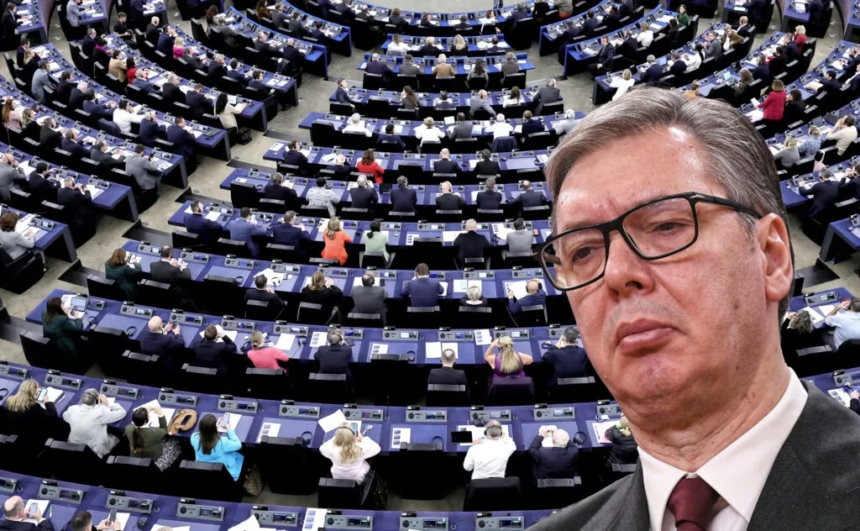
A draft report by the European Parliament has delivered sharp criticism of Serbia’s democratic standards and reform progress, warning that the country’s path toward membership in the European Union has effectively stalled in recent years.
According to the document, seen by media outlets, the lack of progress is primarily linked to serious concerns over the state of democracy, the rule of law, and fundamental freedoms in the country.
The draft report, prepared by the European Parliament’s rapporteur for Serbia, Tonino Picula, states that Belgrade has made limited or no progress in meeting key EU accession benchmarks across several negotiation chapters.
Democracy and Rule of Law Under Scrutiny
The report highlights political polarization, institutional weaknesses, and the need for structural reforms in several critical areas. These include the rule of law, the fight against corruption and organized crime, judicial independence, media freedom, and public administration reform.
“In recent years, Serbia’s progress toward EU accession has stalled, with concerns largely focused on the state of democracy and the rule of law,” the document states.
It further stresses that future progress in accession negotiations should depend strictly on measurable and sustainable reforms.
Calls for Free and Fair Elections Amid Political Crisis
The European Parliament also expresses concern about Serbia’s internal political climate, pointing to mass protests that have taken place across the country since November 2024.
According to the report, these demonstrations reflect deep public dissatisfaction among citizens and students demanding accountability and reforms related to the rule of law.
The document concludes that the most effective way to resolve the political crisis would be to hold free and fair elections, conducted in line with recommendations from the OSCE Office for Democratic Institutions and Human Rights (ODIHR) and ensuring a transparent electoral process.
Concerns Over Police Response and Civil Liberties
The report also raises alarm about the authorities’ response to protests, noting allegations that peaceful demonstrators, students, activists, and journalists have faced a wide range of repressive measures.
These reportedly include excessive use of force, police violence, arbitrary detentions, arrests, and intimidation. The European Parliament has therefore called for urgent, impartial, and transparent investigations into all allegations of disproportionate force by authorities.
Media Freedom and Judicial Reforms Criticized
Another major concern highlighted in the document is the deteriorating environment for journalists and independent media in Serbia.
The report condemns the worsening conditions for media professionals and the broader decline in freedom of expression, noting that the country’s electronic media regulator is still unable to function properly due to the absence of a legitimate and operational governing council.
In addition, the European Parliament expressed serious concern about amendments to key judicial laws adopted by the Serbian parliament on January 28, 2026, warning that these changes risk undermining judicial independence and prosecutorial autonomy.
The report urges Serbian authorities to suspend the implementation of these amendments and carry out an urgent review of the legislation.
Kosovo Normalization Remains Central to EU Path
The document reiterates that normalization of relations with Kosovo remains a key element of Serbia’s European perspective.
It also references security incidents in northern Kosovo, including the 2023 armed attack in Banjska, calling on both sides to fully cooperate in bringing those responsible to justice.
The report specifically notes that Serbia has yet to prosecute individuals involved in the attack, including Milan Radoičić, a senior figure associated with the Serbian political structure in Kosovo.
EU Funding and Democratic Standards
The European Parliament also addressed the EU’s financial support to Serbia through the Growth Plan for the Western Balkans, stressing that such funding should remain tied to the functioning of democratic institutions, free elections, pluralistic media, judicial independence, and the rule of law.
Lawmakers expressed concern over the European Commission’s decision in January 2026 to approve the first payment of funds to Serbia, requesting additional clarification about whether the necessary conditions had been met.
Overall, the tone of the report is described as strongly critical, emphasizing that Serbia’s future progress toward EU membership will depend on tangible results in democratic reforms, rule of law, fundamental rights, and normalization of relations with Kosovo.