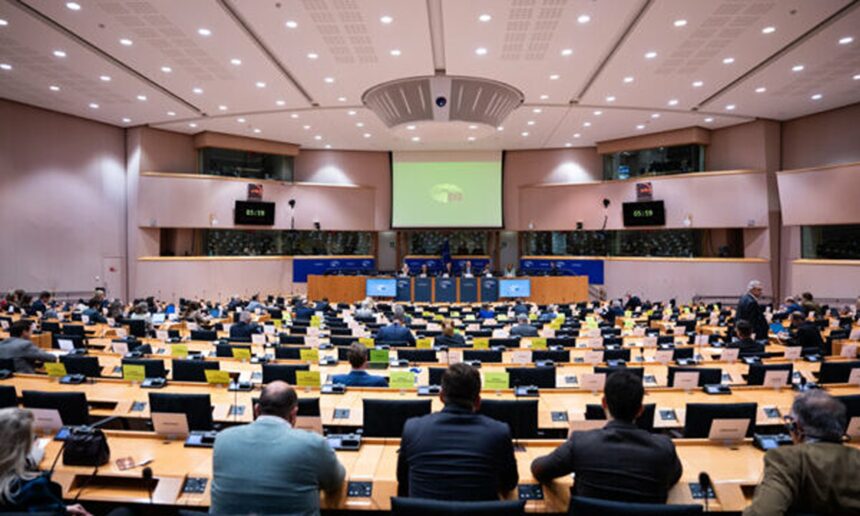
Draft reports on Kosovo and Serbia were presented yesterday to members of the European Parliament’s Committee on Foreign Affairs (AFET).
According to European Western Balkans (EWB), the documents identify deep political crises in both Pristina and Belgrade and call on the parties to resume dialogue aimed at normalizing relations.
The draft report on Serbia notes that the pace of EU-related reforms in the country has slowed significantly, particularly in the areas of the rule of law and democracy.
Meanwhile, the annual draft report on Kosovo, prepared by Riho Terras, EP rapporteur for Kosovo, observes that 2025 “was a lost year” due to the ongoing political crisis.
Kosovo experienced “complete political paralysis, which also affected the reform process,” Terras emphasized.
“It is regrettable that uncertainty and political deadlock have significantly slowed down necessary reforms expected by the European Union from candidate countries, which are also clearly vital for the country itself. There are clearly areas where Kosovo has made substantial regressions over the past year,” he noted during his presentation at AFET.
The document also highlights that the EU-mediated dialogue between Kosovo and Serbia has not been productive.
“The dialogue between Pristina and Belgrade, which began to find an acceptable compromise for both parties, unfortunately did not deliver the expected results. The dialogue was effectively inactive during 2025. This also occurred because Kosovo did not have a government with a full mandate and competencies, and negotiations in this form have no perspective,” it states.
The draft report calls on the European Commission, the European Parliament, and EU member states to do everything possible to ensure that dialogue between Pristina and Belgrade continues with renewed energy, EWB reports.
Furthermore, it stresses the importance of constructive engagement by authorities in both Kosovo and Serbia to reach a comprehensive and legally binding agreement on normalization, which “must be based on mutual recognition and in accordance with international law.”
The document also urges the five EU member states that have not recognized Kosovo’s independence to “move towards recognition, enabling Kosovo to progress on an equal footing with other candidates.”
It additionally supports Kosovo’s requests for EU membership, Council of Europe participation, and NATO integration. These objectives are seen as evidence of Kosovo’s unwavering strategic orientation toward Euro-Atlantic integration.
“Democracy and the rule of law have deteriorated in Serbia”
During the debate following the presentation of the draft report on Serbia, MEPs noted the country’s delays in rule-of-law reforms and called on the European Commission to review the funds allocated under the Growth Plan.
Tonino Picula, EP rapporteur for Serbia, stated that although Serbia declared EU accession as its strategic goal, “the commitments undertaken in practice have not delivered results.”
He recalled that Serbia chose not to participate in the EU-Western Balkans summit while attending a military parade in Moscow.
Picula highlighted serious deficiencies in electoral legislation and stressed that without structural changes and full implementation of all ODIHR recommendations, future elections cannot be considered free and fair.
Furthermore, he noted that changes to key judicial laws “represent an unacceptable step backward in the accession process and a severe blow to judicial independence.”
The draft report, EWB writes, strongly condemns repressive measures and the excessive use of police force and violence against protesters, as well as arbitrary arrests and systematic harassment of opposition members, activists, civil society, and journalists.
“Citizens have the right to demand accountability for widespread corruption because they seek transparency. They have the right to freedom of expression, genuine rule of law, and democratic reforms… There has been a worrying and ongoing attack on academic freedom and autonomy, visible through financial, administrative, and other pressures on the academic community,” Picula emphasized.
He also reminded that the European Parliament’s role includes oversight of the EU budget and funds, including allocations from the Western Balkans Growth Plan.
“It is debatable how Serbia’s stagnation and regression on the EU path are consistent with payments from the Growth Plan,” Picula noted.
According to him, the media situation in Serbia “is frightening on multiple levels.”
“I strongly condemn the escalation of attacks and intimidation of journalists, which has turned the country into a grim period… Freedom of expression is under increasing pressure, while REM has not functioned for a long time… Efforts to eliminate independent media are intensifying… Unfortunately, smear campaigns and toxic disinformation continue to dominate in Serbia,” Picula concluded.