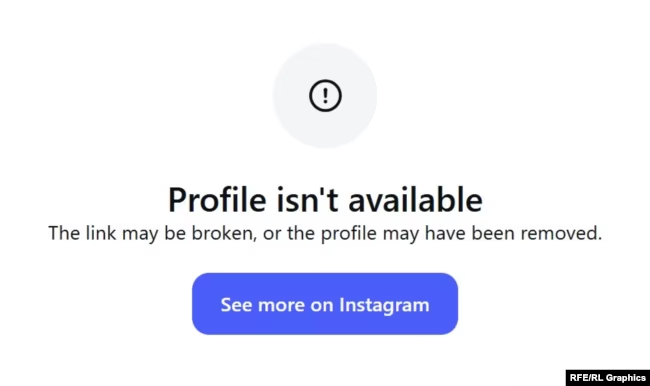
New Instagram profiles, with no followers and only a handful of posts.
This is how almost all of the profiles looked that, in a coordinated manner and within a short period of time, began following critical media outlets and non-governmental organizations in Serbia.
Soon after, the Instagram accounts of these media outlets and organizations were temporarily suspended.
An analysis by Radio Free Europe/Radio Liberty (RFE/RL) shows that these were fake followers. Journalists’ associations and civil society organizations suspect this was a deliberate action aimed at limiting the reach of media outlets that are not controlled by the authorities.
On January 18, the Instagram accounts of more than twenty media outlets, organizations, and individuals in Serbia were suspended or shut down following a sudden spike in followers over a very short period of time.
Meta, the company that owns Instagram and Facebook, interprets such activity as suspicious, which can lead to the suspension or permanent removal of accounts.
“This is an unprecedented case, because many accounts belonging to different actors were affected at the same time—from media outlets and photojournalists to civil society organizations and activists,” Bojan Perkov from Serbia’s Share Foundation, which focuses on digital security, told RFE/RL.
According to him, the problem lies in Meta’s mechanical content moderation, which often targets accounts that have not violated platform rules—exactly what happened in this case.
Most of the profiles that were shut down or suspended on January 18 were reactivated a day later.
RFE/RL asked Serbia’s High-Tech Crime Prosecutor’s Office whether it is investigating the closure of media and civil society accounts on social networks, but no response was received by the time of publication.
Meta confirmed to RFE/RL that its teams restored the accounts that had been mistakenly suspended and said it is working to identify measures to prevent similar incidents in the future.
Bot attacks lasting for months
Shortly before the synchronized shutdowns, several media outlets had publicly warned about “bot” attacks—accounts generated by computers to perform automated actions such as boosting follower numbers or sharing content.
Among them was the portal Nova S, which reported on January 10 an unusual increase in followers on its Instagram account. According to Social Blade data, the account gained more than 40,000 followers in a single day, without any viral content or increased activity. Just one day later, it lost 25,000 followers.
The weekly magazine Radar reported on January 13 that its follower count rose by about 8% in less than two hours. At the same time, similar spikes were recorded on the accounts of Nova S, N1, and the youth portal Zoomer.
According to RFE/RL’s analysis, these profiles display clear characteristics of fake bot accounts: they have no followers, were recently created, all posts were published on the first day, and there was no further activity afterward.
Student organizations’ profiles were also affected, especially those involved in university blockades and mass protests against the Serbian government that began in late 2024.
The Instagram page “Students in Blockade” has nearly tripled its followers in recent months—from around 400,000 to one million. In November 2025, several student profiles were temporarily shut down for similar reasons.
Students have relied heavily on social media as their main communication channels since the protests began.
“Non-transparent rules”
Although many media profiles experienced sudden follower spikes, this was not the case for all suspended accounts.
Data from Social Blade show that the Instagram profile of the NGO CRTA had no unusual activity or follower growth. Jovana Gjurbabić from CRTA told RFE/RL that their account was shut down without any explanation on January 18 and restored a day later—again without justification.
“It is strange and symptomatic that this happened to many different accounts on the same day. Even if the closure was automatic, there had to be an initial trigger for Meta to block it,” she said.
Perkov from the Share Foundation argues that Meta applies non-transparent rules, making it difficult to understand how moderation decisions are made and what consequences they may have.
“This is particularly problematic for accounts from Serbia, which is not an EU member state and therefore not covered by the Digital Services Act, which requires platforms to ensure transparency and provide appeal mechanisms,” he said.
Reactions from journalists’ organizations
Several media associations condemned the shutdown of accounts belonging to Radar, Nova, and other outlets, calling on authorities to urgently investigate who is behind these “bot attacks.”
The Association of Electronic Media (ANEM) described the situation as a “coordinated action aimed at blocking the profiles of independent and professional media.”
The Independent Journalists’ Association of Vojvodina stated that these were not isolated technological incidents, but coordinated attempts at “digital sabotage” targeting independent media that report critically on public affairs.
According to the Council of Europe’s Platform for the Protection of Journalism, Serbia recorded the highest number of attacks against journalists in the Western Balkans in 2025. Of 59 reported cases, 33 occurred in Serbia.
A February 2025 Freedom House report ranked Serbia among the countries with the steepest decline in media freedom over the past decade, citing increased control over media and attacks on journalists—claims denied by Serbian authorities. /RFE/RL