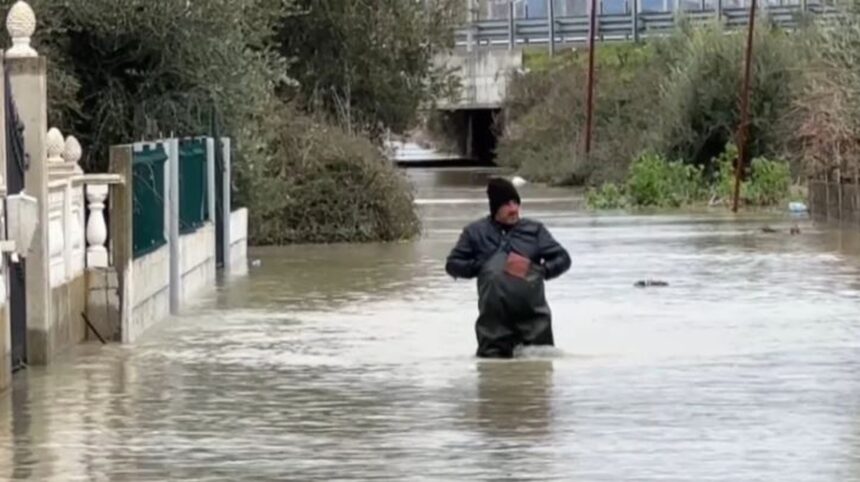
Nearly $2.5 billion in damage has been caused by floods over the past three decades in Albania. Yet, no representative of the institutions responsible for maintaining the country’s hydraulic system, or for assessing and managing risk before and during emergencies, has been held accountable before the justice system, nor has anyone been found guilty.
The scale of the economic damage is revealed in a detailed report by the Supreme State Audit (KLSH), which examined responsibilities at both central and local government levels — from the Ministry of Agriculture to enterprises managing embankments, drainage systems, and sewerage infrastructure.
The findings were made public following KLSH’s audit of the 2024 floods in the city of Vlora, during which hundreds of documents were reviewed, including flood maps, drainage systems, pumping stations, and their maintenance contracts. Beyond highlighting the long-standing failure of responsible institutions to clean drainage canals for decades, the audit raises serious concerns about the ineffective national flood-risk management, which should have been adapted to changing climatic conditions. According to KLSH, this failure contradicts the Civil Protection Law.
The report further reveals that 3,285 structures have been built illegally within irrigation, drainage, and flood-protection infrastructure. This is only one of several critical problems, alongside poor inter-institutional coordination in flood management and the persistent lack of maintenance of the drainage system.
Since 1990, Albania has experienced eight major floods:
- 1995
- September 2002, affecting 7,500 families, mainly in Torovica, Lezha, and Milot
- February–March 2004, flooding of the Drin and Buna rivers
- December 2005, floods in southern Albania caused by the Vjosa River
- 2010–2011 floods in the Shkodër lowlands, during which 12,000 people were evacuated
- February 2015 floods in the south, where 709 homes were completely destroyed
- November 2017 floods along the Vjosa River, damaging 4,700 houses
- Floods in 2021 and 2024 in the areas of Lezha, Shkodër, and Vlora
These events resulted in thousands of hectares of flooded agricultural land, destroyed homes and businesses, and roads temporarily blocked by landslides.
Across all these emergencies, the justice system has opened only two investigations, suspecting that weather alone was not to blame.
The first concerned the 2010 Shkodër floods, after discharge gates were opened at the Vau i Dejës, Koman, and Fierza hydropower plants, causing massive flooding throughout Shkodër, including urban areas. Based on expert assessments by three hydropower specialists, the investigation concluded that the case should be closed, as the opening of the dams was deemed justified.
The second investigation, still ongoing, was launched recently by the Durrës Prosecutor’s Office, not only for destruction of property caused by flooding, but also against individuals suspected of abuse of office during the management of the emergency situation, reports Top Channel.
So far, no suspects have been officially identified in this case either.