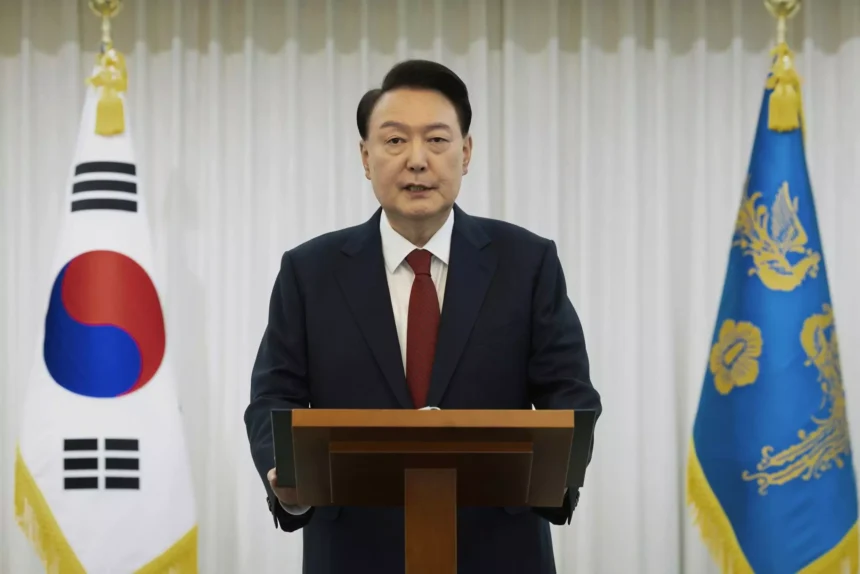
A court in Seoul has sentenced former South Korean president Yoon Suk Yeol to life imprisonment after finding him guilty of leading a rebellion and undermining the country’s constitution.
The verdict, delivered by the Central District Court, marks one of the most significant criminal trials in South Korea in decades. According to the ruling, Yoon destabilized the constitutional order when he declared martial law in December 2024, triggering a prolonged political and institutional crisis. The court concluded that the move went beyond presidential authority and constituted a direct challenge to democratic governance.
Martial Law and a National Crisis
Yoon had justified the extraordinary measure in a televised address, claiming he needed to protect the nation’s liberal democratic order from an opposition he alleged was infiltrated by communist and pro-North Korean elements. No evidence was presented to support those claims.
Shortly after the declaration, armed troops were sent to block the National Assembly. However, lawmakers quickly convened an emergency session and revoked the martial law decree within hours, preventing a wider escalation. The events nonetheless led to Yoon’s removal from office, arrest, and prosecution.
Prosecutors Sought the Death Penalty
Independent special prosecutor Cho Eun Suk had requested the death penalty. However, South Korea has maintained an unofficial moratorium on executions since the late 1990s, meaning the death penalty is effectively suspended in practice. The court ultimately imposed a life sentence. Yoon’s legal team is expected to appeal the decision.
Allegations of Planned Rebellion and Provocation
Prosecutors argued that the former president had planned the imposition of martial law in advance in an attempt to dismantle the constitutional order. The court noted that his actions caused “significant damage and great suffering for the state and society.” Judges also criticized Yoon for failing to offer a sincere public apology or show remorse.
Another accusation presented during the trial claimed Yoon attempted to provoke a confrontation with North Korea for political gain. Investigators alleged he ordered a covert drone operation inside North Korean territory in 2024 to provoke a response that could justify martial law. According to prosecutors, the plan failed because Pyongyang did not retaliate militarily.
Other Officials Also Convicted
Several former officials from Yoon’s administration were also convicted in related proceedings:
- Former defense minister Kim Yong Hyun – 30 years in prison
- Intelligence officer Roh Sang Won – 18 years in prison
- National police chief Cho Ji Ho – 12 years in prison
- Former prime minister Han Duck Soo – 23 years in prison (sentenced earlier)
Yoon Denies All Charges
Yoon has consistently denied wrongdoing, arguing that declaring martial law falls within presidential powers and was necessary to resolve a deepening political crisis caused by a budget standoff with the opposition.
Outside the courthouse, thousands of his supporters gathered demanding his release. Some demonstrators waved American flags, hoping that Donald Trump might exert political pressure or that Yoon could eventually receive a presidential pardon.
Political Landscape After the Crisis
Following the turmoil, South Korea elected a new president, Lee Jae-myung, a center-left leader who had previously been a key opposition figure during the crisis and a long-time political rival of Yoon.
The case underscores deep tensions in South Korean politics and the resilience of its democratic institutions, as the judiciary moved against a former head of state accused of attempting to override constitutional limits.