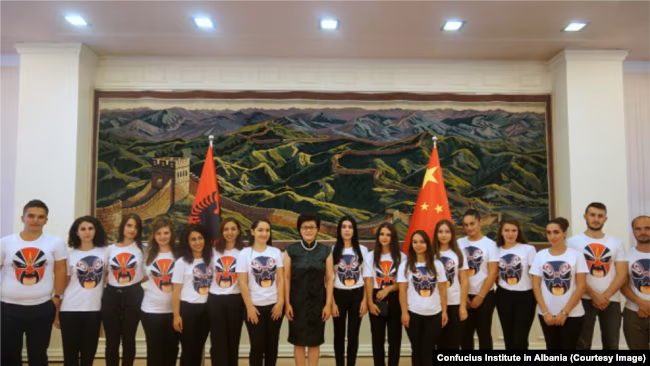
China is increasingly expanding its soft power influence in the Balkans through education programs, scholarships, and digital storytelling, gradually reshaping perceptions among young people in the region, according to analysts and regional reporting.
While Beijing’s multi-billion-dollar infrastructure investments have drawn scrutiny across Europe, China is now turning to softer influence tools, including university exchanges, state-funded scholarships, and social media narratives shared by Balkan students studying in the country.
Education as a Strategic Soft Power Tool
China offers fully funded scholarships, monthly stipends, and access to rapidly developing universities, attracting students from across the Balkans. Many participants actively share their experiences through TikTok, media appearances, and institutional platforms linked to Chinese state outlets, helping promote a more favorable image of the country.
Era Kërnaja, a 24-year-old Albanian student studying computer science at Kunming University of Science and Technology, described how her perception of China has dramatically changed since moving there.
“Three years ago, I saw China simply as a closed communist country. Now my perspective has completely changed,” she told Radio Free Europe.
Kërnaja, who has built a TikTok audience of more than 8,000 followers, says she aims to challenge negative stereotypes about China by sharing her personal experiences.
Analysts Warn of Long-Term Influence Strategy
Experts say these education initiatives are not purely academic opportunities but part of a broader geopolitical strategy.
“Beijing has a clear interest in attracting as many international students and researchers as possible,” said Stefan Vladisavljev, an expert on Chinese influence in the Balkans. According to him, China seeks to cultivate long-term professional networks, favorable narratives, and future decision-makers familiar with Chinese institutions and policies.
This approach complements China’s growing political and economic presence in the region and may gradually increase openness to Chinese investment and diplomatic priorities.
Serbia Emerges as China’s Regional Education Hub
Serbia remains China’s strongest educational and political partner in the Western Balkans, hosting three Confucius Institutes that promote Chinese language and cultural programs across multiple schools and universities. Participation in these programs has grown steadily over the past two decades.
Analysts describe Serbia as China’s primary strategic foothold in both the Western Balkans and wider European engagement efforts.
Mixed Reception Across the Region
Despite strong Western political alignment, countries such as Albania and Kosovo are also witnessing growing interest in Chinese educational opportunities, particularly among younger generations.
Kosovo remains a unique case because China does not recognize its independence, preventing formal academic or institutional partnerships. However, individual students from Kosovo, often through diaspora networks, still pursue education in China and share their experiences online.
For example, Kosovo-born student Vlera Kelmendi, now studying in China, has gained more than 16,000 TikTok followers, sharing positive content about daily life in the country despite generally negative public perceptions of China within Kosovo.
Confucius Institutes Under European Scrutiny
Confucius Institutes, key facilitators of China’s cultural and educational outreach, operate throughout most of the Western Balkans except Kosovo. These institutes provide language courses, scholarship pathways, and cultural programs in cooperation with Chinese universities.
However, several European governments have closed Confucius Institutes, citing concerns about academic freedom, political influence, and transparency. In the Balkans, they remain largely active and popular among students seeking international education opportunities.
Social Media Amplifies Educational Influence
Students returning from China or studying there often act as informal digital ambassadors, sharing daily experiences that reshape public perceptions in their home countries.
Kadir Ismajli, a 26-year-old student from North Macedonia, has built a TikTok following exceeding 31,000 users, posting about life in China.
“People back home tell me they never knew what China was really like,” he said.
Research conducted in North Macedonia suggests that positive perceptions of China tend to be stronger among individuals with direct personal or academic experience with Chinese institutions.
Growing Scholarship Programs Across the Western Balkans
Educational cooperation continues to expand regionally:
- Montenegro has operated a Confucius Institute since 2015 and has sent over 100 students to China.
- Bosnia and Herzegovina maintains formal academic exchange agreements, with more than 170 students participating in Chinese exchange programs, particularly through East Sarajevo University.
- Scholarship programs across the region have steadily increased since the mid-2000s, although comprehensive public data remains limited.
Balancing Opportunity and Geopolitical Influence
Analysts note that China’s strategy mirrors successful Western soft power models, particularly those historically used by the United States to build global influence through education and cultural exchange.
Public opinion across parts of the Balkans remains largely neutral toward China, though surveys show slowly increasing positive perceptions, particularly among younger populations exposed to Chinese education and media narratives.
As Beijing continues to invest in scholarships, cultural programs, and digital outreach, experts warn that China’s long-term influence in the Balkans may increasingly rely on shaping attitudes through education and personal experience rather than traditional political or economic leverage.