World leaders, institutional heads, and global corporate executives have gathered in Davos, Switzerland, for the World Economic Forum (WEF), now in its third day. Key discussions are focused on the war in Ukraine, tensions over Greenland, U.S. tariffs, and the risk of global economic fragmentation. Kosovo’s acting Prime Minister, Albin Kurti, is also participating in the forum.
The WEF 2026, held from January 19–23, brings together leaders and business executives to discuss international conflicts, regional tensions in the Middle East and Latin America, and strategies to support global economic growth and stability.
The forum officially opened on January 20 by Swiss President Guy Parmelin, alongside interim co-chairs of the WEF Foundation Board André Hoffmann and Larry Fink, as well as WEF President and CEO Børge Brende. Participants include Swiss Foreign Minister Ignazio Cassis, Finance Minister Karin Keller-Sutter, Defense Minister Martin Pfister, and California Governor Gavin Newsom.
European Commission President Ursula von der Leyen emphasized that Europe must adapt to a rapidly changing world. She expressed full solidarity with the people of Greenland, calling the U.S. “not just an ally, but a friend,” while warning that escalating tensions could create a negative spiral benefiting strategic adversaries.
French President Emmanuel Macron warned of a global drift from international law and met with Canadian Prime Minister Mark Carney to discuss concerns over U.S. President Donald Trump’s efforts to control Greenland.
U.S. Treasury Secretary Scott Bessent urged European nations to avoid retaliating against Trump’s tariffs, cautioning leaders to “stop and take a deep breath” in a statement to Fox News. Trump is expected to arrive in Davos on Wednesday to meet NATO and European allies.
On Arctic sovereignty, Canadian Prime Minister Carney affirmed Canada’s strong support for Greenland and Denmark, emphasizing the country’s commitment to NATO Article 5.
China’s Vice Premier He Lifeng warned that trade conflicts “have no winners and only increase production and trade costs,” stressing Beijing’s commitment to inclusive economic globalization and describing China as a “trading partner, not a rival.”
Meanwhile, according to sources in the European Parliament, the body may suspend approval of the EU–U.S. trade agreement signed last July between Trump and von der Leyen. The agreement, reached in Scotland, had reduced U.S. tariffs on EU imports to 15 percent.
Following new tariff threats, financial markets reacted negatively. Stock exchanges in the U.S. and Europe recorded declines for the second consecutive day, while the U.S. dollar weakened significantly. The euro rose to $1.1742, and the British pound to $1.346. Precious metals, considered safe-haven assets, reached record levels.
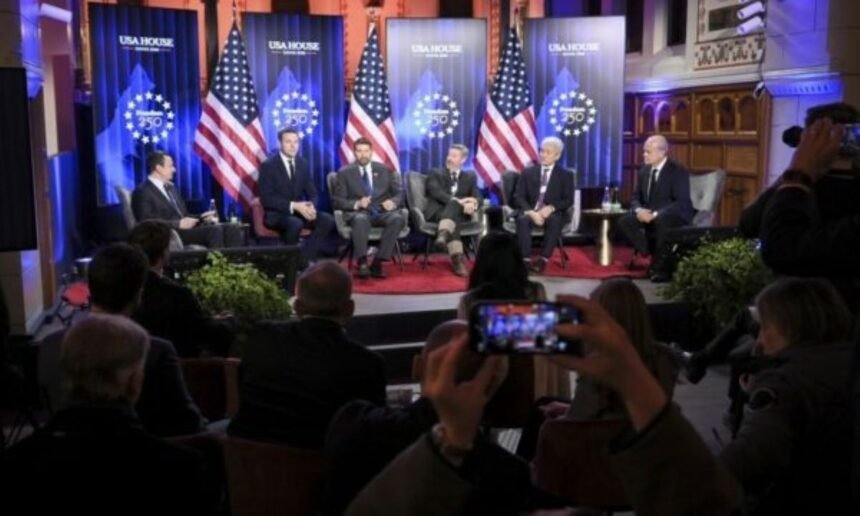
Kosovo’s acting Prime Minister Albin Kurti participated in a panel discussion at the U.S. House in Davos, on the theme “Trust, Leadership, and America 250.”