The trial in the high-profile “Generalštab” case opened this week, and early proceedings have subtly highlighted differences in the statements and positions of the defendants.
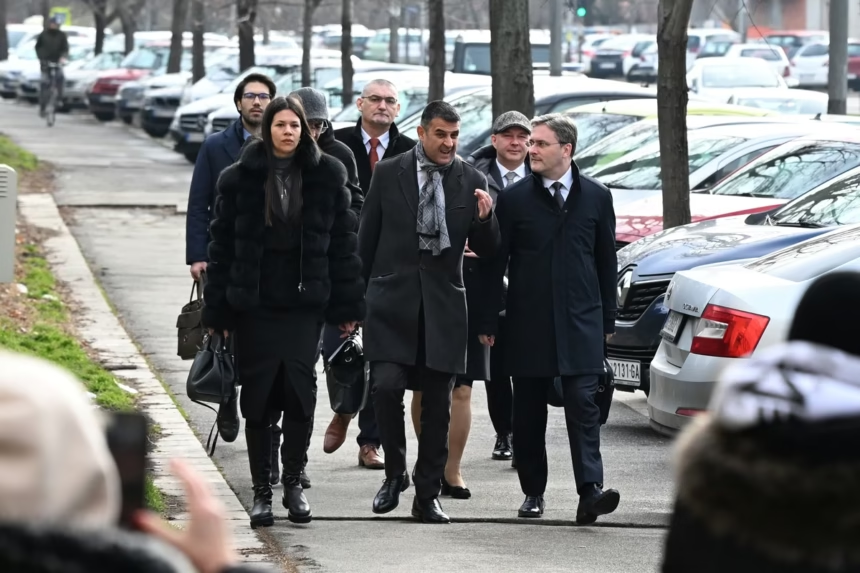
From the outset, the four accused appeared to communicate both verbally and non-verbally in distinct ways. Aleksandar Ivanović, one of the defendants, arrived half an hour early with his sole lawyer and sat slightly apart from the other three, who entered together with a joint legal team. During the court session, Ivanović’s testimony diverged from the almost identical statements delivered by Nikola Selaković, Slavica Jelača, and Goran Vasić, seated together on the defendant’s bench.
Ivanović, who serves as director of the City Institute for the Protection of Cultural Monuments, maintained that he was acting on repeated instructions from a minister to submit a proposal regarding the Generalštab building. He insisted he was not personally responsible for any wrongdoing, emphasizing that the proposal was submitted after a ministerial insistence and procedural adjustments within the ministry.
His lawyer, Ljubiša Vučetić, clarified that Ivanović’s defense would focus solely on procedural matters, noting that no cultural heritage status had been removed and thus the alleged crime had not been fully executed.
Legal experts and retired prosecutors observing the trial noted that the existence of a lex specialis governing the protection of Generalštab complicated the charges. Jasmina Paunović, a retired prosecutor, explained that the special law effectively safeguarded the building as a cultural monument, and that the criminal complaint followed its enactment, limiting the scope of potential liability.
The composition of the legal teams further reflects the case’s political sensitivity. While prominent lawyers such as Dragan Palibrk and Vladimir Đukanović are involved, the presence of Igor Isailović, an attorney known primarily for business law rather than criminal cases, has drawn attention.
Observers suggest that these early differences in testimony and strategy may indicate diverging approaches among the defendants as the trial proceeds, potentially shaping the legal and political ramifications of the case.