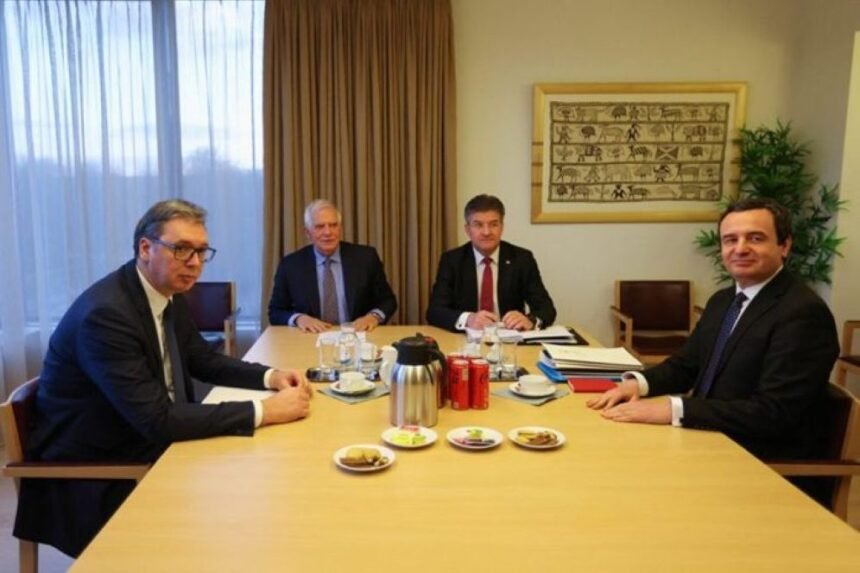
The German Aspen Institute has identified the normalization of relations between Kosovo and Serbia as a key barrier to their European Union accession, noting that Serbia is a particular obstacle for Kosovo’s progress.
Kosovo is recognized as a potential EU candidate, but despite progress in several areas, it still faces significant challenges, with diplomatic normalization with Serbia weighing most heavily. The same applies to Serbia, which began EU accession negotiations in 2014, yet progress remains limited due to concerns over rule of law reforms, media freedom, foreign policy alignment, and relations with Kosovo, according to the report.
“Western Balkans countries continue to face structural challenges, including weak rule of law, politicized state institutions, and limited administrative capacity, which hinder policy implementation and erode public trust,” the report states.
The report highlights the impact of disinformation campaigns, originating both domestically for political gain and externally to undermine democratic stability and weaken EU integration support.
Demographic challenges remain a pressing concern, as the region experiences a shrinking population and significant “brain drain”, impacting economic modernization and long-term workforce sustainability.
“What was once considered temporary emigration has become a structural issue, as young and skilled workers leave in search of opportunities, while aging populations and low labor participation reduce local workforce capacity,” the report notes.
In terms of skills and education, all six Western Balkan states—Albania, Kosovo, North Macedonia, Serbia, Montenegro, and Bosnia-Herzegovina—fall below EU standards. Despite rising education levels, employers report shortages of qualified workers, exacerbated by low wages and limited career opportunities compared to EU countries.
The report praises Albania and Montenegro for leading the region in reforms, particularly Albania’s efforts to modernize digital infrastructure through initiatives like e-Albania, which centralizes public services. However, the report also underscores persistent cybersecurity gaps, citing the 2022 cyberattacks linked to Iran, which exposed weaknesses in data protection and system resilience.
The report stresses that media freedom, political pressure on journalists, and institutional independence of the Data Protection Commissioner remain areas of concern. Collaboration with the EU and NATO has improved digital readiness, yet the need for capacity building remains high.
Finally, the report places EU enlargement at a strategic crossroads, influenced by the Russian invasion of Ukraine and internal skepticism about integration of new members. Some EU states argue that institutional consolidation is a prerequisite for accession, while others see enlargement as a catalyst for modernization and institutional reform.
“The EU continues to strive for a predictable and strategically consistent enlargement process,” the report concludes.