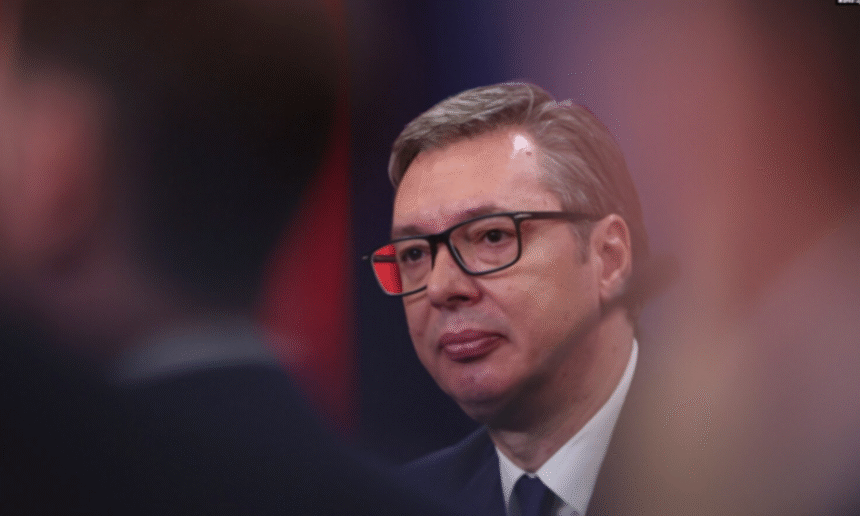
German-language media report that Serbian President Aleksandar Vučić made extensive efforts to enable the demolition of the General Staff complex in Belgrade, despite growing legal, institutional, and public resistance. The controversial redevelopment project ultimately collapsed following criminal indictments against Serbia’s Minister of Culture, according to reports cited by Deutsche Welle (DW).
The Swiss daily Neue Zürcher Zeitung (NZZ) reports that Jared Kushner, son-in-law of U.S. President Donald Trump, has withdrawn his planned real estate project from the Serbian capital. Kushner’s company, Affinity Partners, announced that the project was suspended “out of respect for the people of Serbia and the city of Belgrade.”
In an article titled “Belgrade Will Not Get a Trump Tower,” NZZ notes that the decision came only hours after Serbia’s Organized Crime Prosecutor filed charges against the Minister of Culture, who is accused of abuse of office and document falsification related to the project. The minister has denied all allegations.
According to the Swiss newspaper, the indictment represents the culmination of an 18-month dispute involving heritage conservation experts, opposition politicians, protesting citizens, and students, who opposed the demolition plans. From the outset, the project was dogged by corruption allegations, the report states.
Pressure on Cultural Heritage Institutions
At the center of the controversy is the General Staff complex, a historic group of buildings located between Belgrade’s old city center and the upscale Belgrade Waterfront development. Kushner’s company planned to build a luxury hotel, shopping center, and 1,500 apartments, with an estimated investment of $500 million.
The complex served as the headquarters of the Yugoslav Army and was bombed by NATO in 1999 during the air campaign against Serbia. Since 2005, it has been protected as a cultural monument.
Despite this status, Kushner and the Serbian government reached an agreement in early 2024 to redevelop the site, which included demolition. Initial objections from heritage protection authorities were viewed as manageable, NZZ reports.
The newspaper writes that Vučić strongly supported the luxury hotel project and that intense pressure was placed on the directors of both the national and Belgrade heritage institutes to revoke the site’s protected status. Both directors refused and were subsequently dismissed.
Their successors, according to NZZ, proved more cooperative, and in November 2024 — shortly after Trump’s election victory in the United States — the Serbian government revoked the General Staff’s status as a cultural monument.
Legal Fallout and Criminal Charges
However, serious doubts soon emerged regarding the legality of the process. In May and September 2025, prosecutors questioned the two newly appointed heritage institute directors. One reportedly admitted to falsifying documents, while the other stated that all decisions were made on explicit orders from the Ministry of Culture.
As a result, Culture Minister Nikola Selaković became the focus of the investigation.
NZZ emphasizes that the judiciary’s sudden move against a senior government and ruling party official clearly unsettled President Vučić. The paper adds that in Serbia, major decisions are not made without Vučić’s knowledge — if not his direct approval — particularly in projects of this magnitude.
The Swiss daily concludes that Vučić and his party attempted until the very end to discredit the prosecution, while noting that Vučić did everything possible to enable the demolition, even though heritage institutions ultimately refused to remove the complex from the protected list.
Public Protests and International Coverage
For months, conservationists, architects, opposition figures, and students staged protests outside the General Staff complex, opposing the hotel project.
Germany’s Der Spiegel, under the headline “Luxury Hotel Project by Trump’s Son-in-Law in Belgrade Canceled,” described the outcome as a “successful protest in Serbia.” The magazine reported that Vučić accused demonstrators of conducting a “hysterical blockade campaign.”
Der Spiegel quoted Vučić as calling the withdrawal “an incredibly difficult and bad piece of news,” adding: “We will now be left with a ruined building.”
The magazine explained that the building’s symbolic importance stems from the 1999 NATO airstrikes, during which civilians were also killed in misdirected attacks. The ruined structure, declared a cultural monument in 2005, remains a powerful reminder of those events.
According to Der Spiegel, Vučić had actively supported the project, hosted Kushner multiple times in Belgrade, and backed a law passed in early November intended to fast-track the luxury hotel development.
In closing, the magazine reports that Vučić blamed “blockaders” for destroying investments worth at least €750 million, stating that “as a state and as a nation, we are major losers.” He also accused state prosecutors of inflicting “enormous damage” on Serbia.