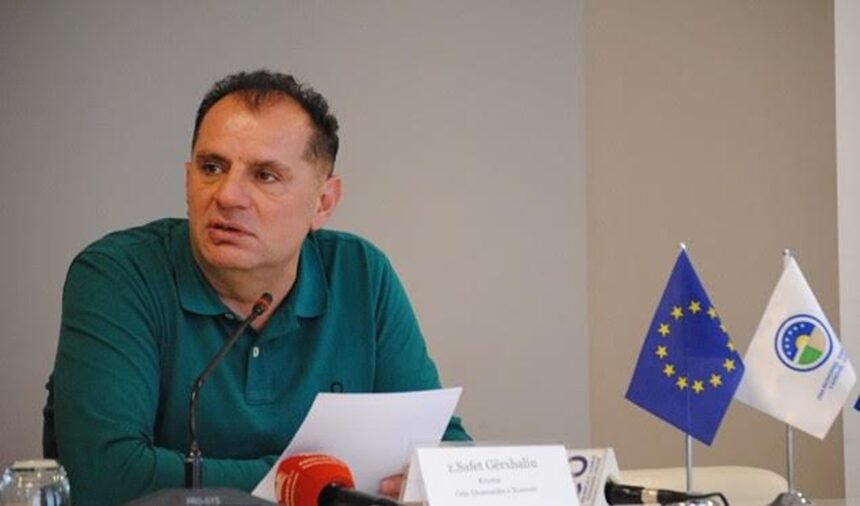
The former president of the Kosovo Chamber of Commerce, Safet Gërxhaliu, has assessed that the punitive measures imposed by the European Union against Kosovo did not produce negative consequences only for Kosovo’s economy and institutions, but also for European companies and consortia operating in the country.
In a Facebook reaction, Gërxhaliu emphasized that projects financed by the EU and other international donors have traditionally been mutually beneficial.
“Numerous projects financed by various donors, including the EU, represent opportunities not only for Kosovo, but also for European implementing companies,” he wrote.
According to him, a large portion of the funds allocated to Kosovo ultimately return to EU member states through implementing companies.
“The preparation of tenders, technology transfer and know-how systems, consultancy, design, monitoring, reporting, airline tickets, high salaries and daily allowances, expensive hotels, and risk payments have absorbed the largest share of the financial value of an EU-funded project or donation,” Gërxhaliu stressed.
He added that now, as the measures are gradually being lifted, it is becoming clear that they also had consequences for European organizations implementing projects in Kosovo.
“From the funds that the EU allocates to Kosovo, entities from the EU itself often benefit as well, meaning that part of that money remains within the EU,” he assessed.
Gërxhaliu underlined that the suspension or slowdown of projects created a negative chain reaction.
“These measures affected the interruption of cooperation, delays in implementation, increased operational costs, and the loss of opportunities for European partners,” he stated, adding that the consequences were felt both in cooperation with Kosovo institutions and in the direct implementation of projects.
According to him, the EU’s comprehensive measures undermined not only local socio-economic development, but also the credibility of European engagement in Kosovo.
“These measures created a chain effect that undermined the efficiency, interest, and credibility of European engagement in Kosovo,” Gërxhaliu emphasized.
He further noted that for Kosovo, the consequences were also severe in terms of international image.
“Being the only European country after Russia and Belarus to face such measures does no honor to Europe’s youngest state,” he declared, adding that the measures were “a heavy blow to investments and foreign investors, who for several years bypassed Kosovo,” he concluded.