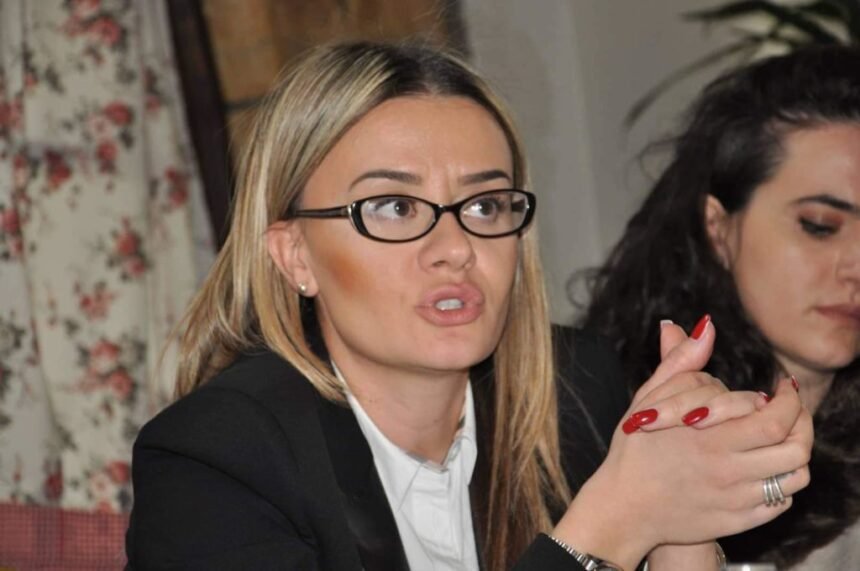
Former Kosovar diplomat Meliza Haradinaj has sharply criticized Serbian President Aleksandar Vučić, arguing that his recent claims about the “collapse of international law” reflect concern over the growing accountability of authoritarian regimes, rather than genuine legal principles.
In a series of posts on X, Haradinaj stated that the international order is strengthened—not weakened—when regimes that violate sovereignty, suppress democracy, and export instability are confronted.
Vučić’s Concerns Rooted in Shrinking Authoritarian Alliances
According to Haradinaj, Vučić’s rhetoric should be understood as a reaction to the erosion of protection enjoyed by leaders such as Vladimir Putin, Nicolás Maduro, and Bashar al-Assad, whom she described as anti-Western authoritarian allies.
“When Vučić claims that international law no longer exists, he is not worried about law,” Haradinaj wrote, “but about the accountability closing in on his political circle.”
She added that the recent U.S. operation against Venezuela’s President Nicolás Maduro signals a broader shift in global enforcement, where power without accountability is no longer immune from consequences.
Venezuela and Serbia: Parallel Roles in Their Regions
Haradinaj argued that Venezuela under Maduro became a source of regional and global instability, citing mass displacement, narcotics trafficking, and the expansion of Russian and Iranian influence in the Western Hemisphere, which she said directly threatened U.S. national security.
She further claimed that Serbia plays a comparable role in the Western Balkans, describing it as a strategic hub for Russian, Iranian, and Chinese influence, while exerting pressure on neighboring states and restricting democratic freedoms at home.
“Serbia has long become a direct link to narco-regimes and anti-U.S. allies such as Cuba and Venezuela,” she stated.
Record of Selective Respect for International Law
Haradinaj outlined what she described as a consistent Serbian pattern of selectively invoking international law:
- Serbia requested an advisory opinion from the International Court of Justice on Kosovo’s independence, but rejected the ruling when the court concluded that Kosovo’s declaration did not violate international law.
- Post-war accountability remains obstructed, with Belgrade accused of denying or relativizing crimes from the Milošević era, restricting access to archives, and withholding information on mass graves. More than 1,600 people from the Kosovo war remain missing.
- Convicted war criminals are often publicly rehabilitated, rather than treated as violators of international humanitarian law.
Beyond the Balkans, she highlighted that Serbia continues to refuse condemnation of Russia’s war in Ukraine, while maintaining close political ties with Moscow.
“Directly and deliberately, Vučić works against international law,” Haradinaj asserted.
Kosovo’s Position: Enforcement as a Pro-American Stance
Haradinaj emphasized that Kosovo’s position remains firmly aligned with the United States, framing support for accountability and enforcement as essential to global stability.
“Supporting enforcement and confronting aggression is a strictly pro-American stance,” she concluded. “It strengthens global security, protects democracy, and reaffirms the United States’ role as a guarantor of stability.”