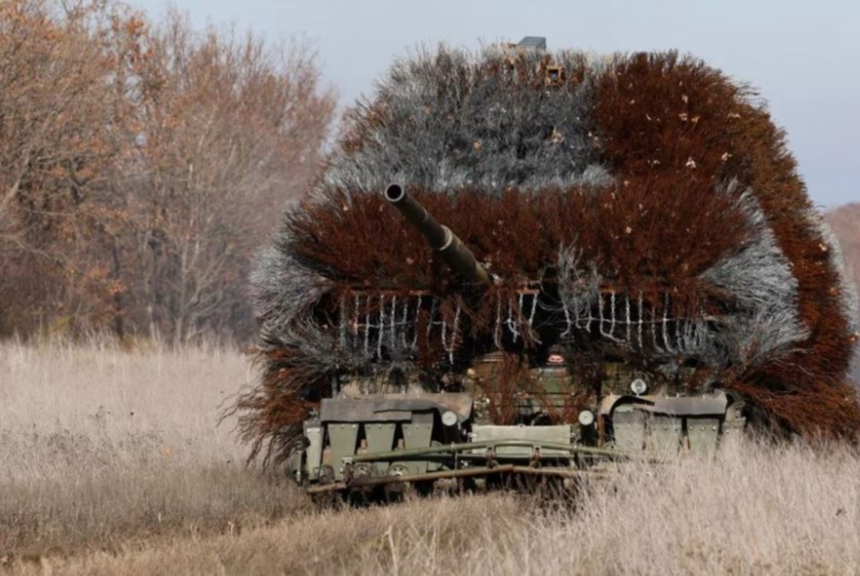
As seen in the photo below, a tank covered with thick metal wires is one of the clearest examples of what the Ukrainian army has been using since this autumn to defend against Russian occupying forces.
The new protective system is reported to be created from steel cables cut to equal lengths, then stripped into separate wire strands. In the end, the spiked wires are mounted onto tanks or other military vehicles.
Both sides in the war in Ukraine have tried to avoid drone strikes using this type of protection, commonly known as “hedgehog armor.”
A Russian tank equipped with hedgehog armor in the Ukrainian region of Donetsk.
Iryna Rybakova, media officer for Ukraine’s 93rd Mechanized Brigade, told Radio Free Europe/Radio Liberty that the “soft” armor is designed “to tangle drones so they do not detonate, or to make them explode at a distance.”
Most kamikaze FPV drones are equipped with a fuse protruding from the tip, which detonates upon impact. The new spiked armor can entangle such a drone before its fuse reaches a solid surface.
Rybakova says that a “Russian hedgehog tank” seen near Toretsk in the Donetsk region managed to withstand dozens of hits from Ukrainian FPV drones before finally being destroyed. According to her, the hedgehog shield provides less protection against larger and faster kamikaze drones.
Russian soldiers with a tank equipped with hedgehog armor in Donetsk region, November 2025.
Carlo Masala, a professor and military expert at the Bundeswehr University in Munich, told RFE/RL that the new anti-drone armor “appears to be a new tactic aimed at bringing maneuver warfare back into the battlefield.”
With cheap FPV drones capable of destroying tanks worth millions, both sides have been forced to limit the use of armored vehicles that once stood at the center of military tactics.
In recent months, Masala notes, there have been “only small raids by a few soldiers behind enemy lines.” Large troop and vehicle movements mostly happen on foggy days when low visibility reduces the risk of detection.
A member of a Russian tank crew.
However, this unusual type of protection is believed to come with severe drawbacks for tank crews.
A Russian tank driver recently told a media outlet that his unit uses tanks with hedgehog armor. According to him, due to the added weight, the tank “did not make it even 10 kilometers before one of the [transmission components] failed.” He added that the heavy armor causes “extreme stress on the tank’s components.”
Masala believes such flaws “seem to be accepted if it means restoring maneuverability in the war.”
Ukrainians adjusting plastic wires that will later be mounted on a tank.
Spokeswoman Rybakova recounted witnessing an early version of the hedgehog armor when a Ukrainian team tied plastic cables designed to snag drone propellers.
The heavy vehicle was used as bait to divert attention away from Ukrainian troops withdrawing from their positions. “Enemy drones flew toward the tank. It took around five or six hits, which the crew barely felt,” Rybakova said.
“But then the enemy dropped an anti-tank mine,” which, according to her, set the vehicle’s engine on fire.
“It’s a pity about the tank, but the people survived and the mission was accomplished,” she added.