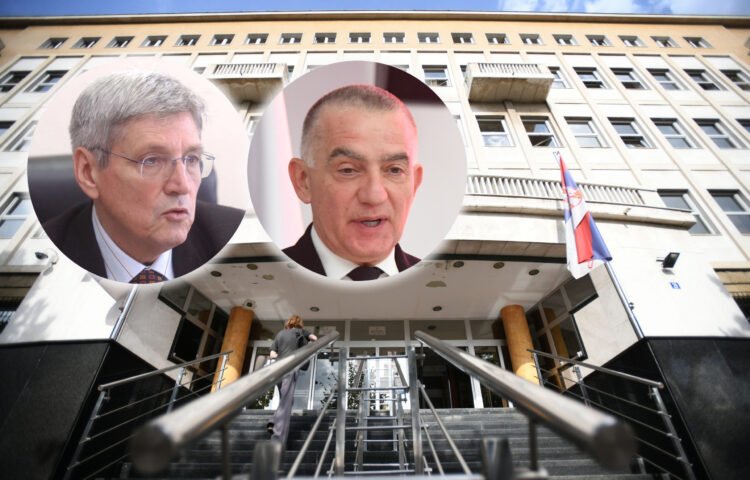
The ruling Serbian Progressive Party (SNS) has intensified its attacks against the Public Prosecutor’s Office for Organized Crime (JTOK), signaling a coordinated political effort to neutralize and effectively dismantle one of Serbia’s last independent judicial institutions.
Over the past months, SNS officials and pro-government media have openly pushed for JTOK to be placed under the control of the Higher Public Prosecutor’s Office in Belgrade, led by Nenad Stefanović—a figure widely criticized for his loyalty to the ruling party.
This is not the first attempted assault on JTOK. But analysts warn that today’s pressure is far more aggressive, more systematic, and more closely tied to the personal political survival of President Aleksandar Vučić’s inner circle.
A Turning Point: Investigations Into SNS Corruption
Tensions escalated after JTOK launched an investigation into corruption related to the collapse of the Novi Sad railway station canopy, an incident that killed 16 people. The probe reached two high-profile SNS officials, Goran Vesić and Tomislav Momirović—a rare challenge to the ruling party’s impunity.
Soon after, JTOK opened another politically sensitive case: the “Generalštab” affair, involving current Minister of Culture Nikola Selaković, one of Vučić’s closest allies.
Selaković has responded with aggressive, undignified attacks on prosecutors, a behavior critics describe as “institutional vandalism.”
The louder JTOK becomes, the louder the SNS campaign to destroy it.
A Strategy of Discrediting and Threats
The ruling party has engaged in:
- Public insults and intimidation of Chief Prosecutor Mladen Nenadić
- Calls to abolish both JTOK and the Special Court
- Proposals to place both bodies under direct political control
Legal experts warn that these actions form a clear pattern:
whenever the justice system approaches the ruling elite, Vučić’s regime attempts to dismantle it.
This Has Happened Before—But the Stakes Are Higher Today
A similar attempt occurred in 2004 under a different government, when then-Minister of Justice Zoran Stojković (DSS) proposed eliminating the Special Prosecutor’s Office and transferring all cases to regular courts. The justification at the time was financial cost—a claim widely dismissed as false.
The attempt failed due to strong opposition from the EU and the U.S., which viewed the Special Court as essential for prosecuting war crimes and organized crime.
Former judicial correspondent Ivan Stojković notes:
“The same motives appear today: political fear and a desire to shield individuals in power from prosecution.”
EU and U.S. Opposition Could Again Play a Decisive Role
Analysts warn that any attempt by Vučić’s government to abolish JTOK or the Special Court would have severe consequences for Serbia’s EU accession talks.
“If the regime proceeds with this plan, EU negotiations would collapse overnight,” Stojković explained.
The Special Court’s creation was heavily funded by EU member states—including infrastructure, training, and security systems—making its abolition a direct affront to Serbia’s strongest international partners.
SNS Arguments Collapse Under Scrutiny
SNS official and lawyer Vladimir Đukanović recently argued that JTOK’s “large number of acquittals” makes it too costly for the state.
But critics point out that:
- He ignored the millions recovered through asset seizures in JTOK-led cases
- He minimized the need for specially trained judges and prosecutors
- He overlooked that the Special Court handles the most complex, high-risk criminal cases, including organized crime and political corruption
Moreover, Special Court judges were required to sign statements acknowledging that the state would not be responsible for their personal safety—a reminder of the high stakes involved in prosecuting organized crime.
A Regime Trying to Protect Itself
Legal analysts widely agree that the true motive behind the attacks on JTOK is simple:
fear.
Fear within the ruling elite that investigations into organized crime, corruption, and political abuse of office will eventually reach the highest levels of Vučić’s regime.
The more JTOK acts independently, the more aggressively the government seeks to cripple it or absorb it into politically controlled structures.
Serbia has been here before—
but never with this level of political pressure, institutional capture, and open hostility toward judicial independence.