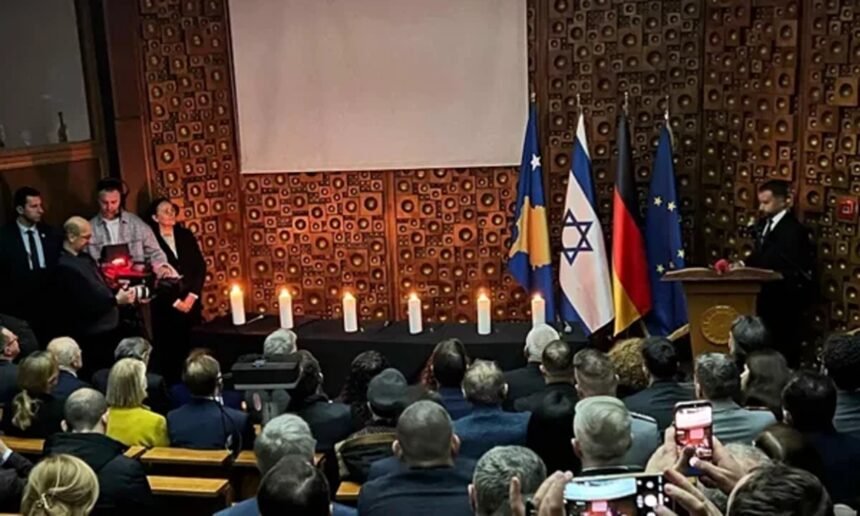
On the occasion of the International Day of Commemoration in Memory of the Victims of the Holocaust, a commemorative ceremony was held this evening at the amphitheater of the National Library in Prishtina.
The event was attended by foreign diplomats, institutional representatives, and members of civil society.
In remembrance of the six million Jews murdered during the Holocaust, six candles were lit, KosovaPress reports.
The Ambassador of Israel to Kosovo, Tamar Ziv, stated that hatred against Jews continues even today, noting that physical attacks and hate speech are reported daily.
“The Holocaust was the ultimate denial of human rights and human dignity. It stemmed from an antisemitic ideology that stripped people of their rights, dehumanized them, and declared certain races to be subhuman and therefore dangerous to society and to be eliminated. Antisemitism—the hatred of Jews—did not end with the Holocaust 81 years ago. It has transformed into Holocaust denial rhetoric, physical attacks against Jews and Jewish communities worldwide, and calls for the destruction of the State of Israel. Antisemitism is rising at alarming rates and spreading across societies, countries, and continents, transcending political and ideological divides. Jewish communities in dozens of countries report daily incidents, including threats, physical attacks, vandalism, and hate speech in public spaces and on social media, as well as deadly violence. Jews are once again being targeted simply for being Jewish. Synagogues, Jewish communities, and Jewish community centers require protection. Jews hide visible symbols of their identity to avoid being recognized and threatened, while Jewish students feel unsafe on university campuses,” she said.
She added that “it is unimaginable that in 2026 Jews around the world are living in fear.”
“The largest wave of antisemitism since World War II followed Hamas’ attack on Israel on October 7. The statistics on antisemitic incidents are shocking. During the last three months of 2023 alone, following the October 7 attack, more than 1,700 antisemitic incidents were documented. In 2024, this number doubled to over 6,300 incidents, and 2025 recorded a further increase. Since October 7, more than 13,000 antisemitic incidents have occurred worldwide, including deadly attacks in the United Kingdom, the United States, Europe, and Australia, in which more than 20 Jews were killed solely because they were Jewish. The most recent horrific attack took place in December at Bondi Beach in Australia, when a crowd of thousands gathered to celebrate the first night of Hanukkah, the Jewish Festival of Lights. What should have been a moment of joy and unity turned into a moment of grief and terror when two armed individuals opened fire on the crowd, killing 15 innocent people, including a 10-year-old child and an elderly Holocaust survivor, and injuring dozens more,” she emphasized.
At the commemorative ceremony, President Vjosa Osmani said that the Holocaust was an attack against humanity itself.
“Tonight we have gathered to remember and honor six million Jewish women, men, and children who were systematically murdered during the Holocaust, as well as millions of other innocent victims targeted by the Nazi regime. The Holocaust was not merely an attack against one people—it was an attack against humanity itself. This time last year, together with other world leaders, I stood at Auschwitz-Birkenau. Amid the remnants of unimaginable cruelty, one message echoed with particular force: our past must never become our children’s future. This is a message that must guide our conscience, our choices, and our actions. At Auschwitz, we remembered millions of innocent children, women, and men who fell victim to a hatred so profound that it sought to erase their very existence,” she said.
President Osmani emphasized that Kosovo has personally experienced ethnic cleansing and crimes against humanity.
“Kosovo is a country that understands, in a deeply personal way, what it means to suffer persecution, ethnic cleansing, war crimes, crimes against humanity, and genocide. This lived experience shapes who we are today. That is why Kosovo stands firmly and unequivocally against antisemitism, against racism, and against all forms of hatred,” Osmani added.
She further stressed that remembrance is a responsibility, noting that “Kosovo has turned this principle into concrete action.”
Meanwhile, the Ambassador of Germany to Kosovo, Rainer Rudolph, stated that remembering Auschwitz is a historical responsibility.
“On this day, 81 years ago, the scale of Nazi crimes was revealed when Soviet soldiers liberated 7,000 severely malnourished, gravely ill, and deeply traumatized survivors from the largest Nazi extermination camp. Like no other place, Auschwitz stands as a symbol of horror—the merciless murder of millions of innocent men, women, and children, primarily Jews, who were systematically persecuted and killed by the Nazis. I first visited the Auschwitz memorial as a 17-year-old student, and the image that remains etched in my memory is that of the single railway track ending there, because for those deported there, there was neither a journey forward nor a return. For Germany, remembering and commemorating the Shoah is a permanent historical responsibility and a moral duty. We will never forget the unprecedented crimes committed in the name of Germans and by Germans, nor the immeasurable suffering inflicted upon the victims,” he concluded.
Rron Hoxha delivered a speech on behalf of his grandmother, Igballe Mullashabani Hoxha, whose family sheltered Jews in their home in Gjakova during World War II.
“She remembers that time as a cold period—winter or early spring—a coldness not only of the weather but of an era in which fear and danger were part of everyday life. In her family home in Gjakova, several Jews were sheltered: a married couple, husband and wife, and a young man who was their relative. They remained hidden for about five months in a room on the second floor of the house. During the day, they never left the house, and only at night, when only family members were present, could they go out into the yard and walk, always fearing that someone might see them,” he concluded.
On January 27, the International Holocaust Remembrance Day—designated by the United Nations General Assembly in 2005—the victims of the Holocaust are commemorated.
This date marks the liberation of the Nazi concentration camp Auschwitz-Birkenau on January 27, 1945.