Recent court rulings in Bosnia and Herzegovina related to the denial of the Srebrenica genocide and the glorification of war criminals have been welcomed as an important step toward the enforcement of the law.
However, for many observers of political and judicial developments in the country, these rulings have also raised a fundamental question: why does justice act against individuals with no political influence, while powerful figures remain untouched?
This issue was at the center of a debate on the program Bridge by Radio Free Europe/Radio Liberty’s Balkan Service. Participants emphasized that although genocide denial has been criminalized since 2021, the enforcement of the law remains selective and delayed.
First Convictions After Years of Silence
Courts in Bosnia and Herzegovina recently sentenced Miodrag Maljić and Vojin Pavlović for glorifying war criminals and denying the genocide in Srebrenica.
These were the first convictions since the country’s Criminal Code was amended in 2021 to prohibit the denial of genocide and crimes confirmed by international courts.
Vehid Šehić, president of the Tuzla Citizens’ Forum, said these rulings were not surprising—but long overdue. According to him, the law has existed for years, yet institutions have hesitated to apply it in practice.
“We live in a time when war criminals have effectively become national heroes. There has been no genuine environment for confronting what happened during the war in Bosnia and Herzegovina,” Šehić said.
He added that justice in Bosnia and Herzegovina often reacts only under public pressure, creating the impression that the law is not a priority but a tool used selectively.
Who Was Convicted—and Why?
On January 26, the Court of First Instance of Bosnia and Herzegovina sentenced Miodrag Maljić to three years in prison for glorifying war criminals Radovan Karadžić and Ratko Mladić.
Two months earlier, the Appellate Court confirmed a sentence of three and a half years in prison for Vojin Pavlović for glorifying war criminals and denying the Srebrenica genocide.
These were the first such rulings since July 2021, when then–High Representative Valentin Inzko amended the Criminal Code to criminalize genocide denial and the glorification of war criminals.
Since those amendments, more than one hundred criminal complaints have been filed, but only recently have the first convictions been issued.
Branko Todorović, Executive Director of the Helsinki Committee for Human Rights in Bosnia and Herzegovina, said these rulings show that the judiciary “can act when it wants to.”
“However, they do not change the fact that political elites in Bosnia and Herzegovina have had a consensus for nearly 30 years to protect war criminals and their networks,” he said, describing the rulings as signs of a “late and selective awakening” of the judiciary.
Dodik and the Double Standard
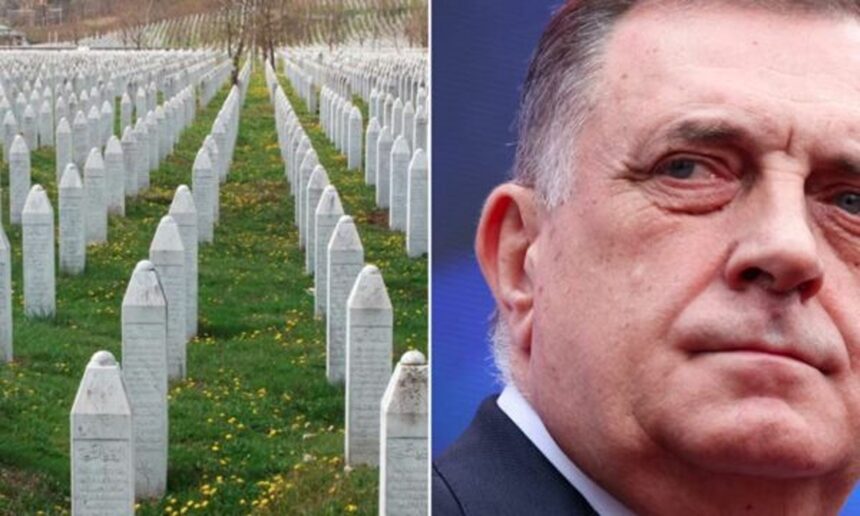
Bosnian Serb leader Milorad Dodik has publicly denied the Srebrenica genocide dozens of times—including after the law came into force—according to monitoring organizations. Yet, no indictment has been brought against him.
Todorović says this clearly demonstrates the lack of equality before the law.
“For years, judicial institutions in Bosnia and Herzegovina have sent the message that politicians are above the law. Laws apply only to ordinary citizens, not to political leaders who glorify war criminals, deny genocide, and are involved in corruption and crime,” he said.
One of the main reasons many criminal complaints are dismissed, prosecutors argue, is the lack of proof of intent to incite hatred or violence.
Šehić strongly disagrees with this interpretation.
“Genocide denial is a criminal offense in itself. There is no need to prove intent to incite violence. Denial alone is an insult to the victims,” he said, adding that the Prosecutor’s Office is “a captured institution that is not allowed to act.”
According to him, recent convictions targeted individuals unknown to the public, while high-ranking politicians continue to glorify war criminals and deny genocide without any consequences.
Todorović stressed that the problem extends beyond the prosecution and reflects society’s broader attitude toward war crimes.
“There is no indication that this attitude has changed in the past four or five years. On the contrary, society remains in the same position it was 15 or 20 years ago,” he said.
In this context, recent convictions appear to be the exception rather than the rule, while Bosnia and Herzegovina remains far from establishing an independent prosecutorial system free from political pressure.
“With our current approach to war crimes, we are leaving an enormous burden to future generations. And that legacy is terrifying—because war crimes are not only left unpunished, but are glorified, and their perpetrators are often declared national heroes,” Todorović concluded.
/RFE/RL