
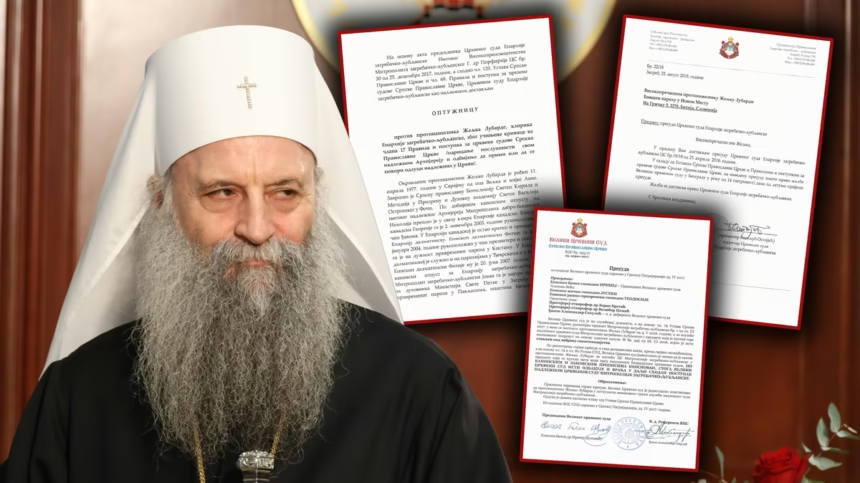
While Slovenia is examining the potential criminal liability of the Patriarch of the Serbian Orthodox Church, Porfirije, over alleged workplace abuse of priest Željko Lubarda, documents obtained by RKS New show that Porfirije had previously acted as the judge in church proceedings against the same priest. As Metropolitan of Zagreb-Ljubljana, Porfirije initiated a church procedure against Lubarda in 2016 after the priest refused to comply with a decision transferring him from Slovenia to Croatia. Slovenian court and prosecutorial documents later described the move as retaliation for Lubarda’s participation in proceedings against former priest Peran Bošković.
Lubarda, who holds a master’s degree in theological sciences, says the procedure violated the Constitution of the Serbian Orthodox Church. According to him, the church constitution does not prescribe punishment for refusing a parish assignment but only the loss of the right to that parish. He also noted that the decision would have been his fourth transfer within four and a half years.
He further claimed that during the trial at the Ecclesiastical Court in Zagreb, another priest participated alongside Porfirije despite not meeting the constitutional requirements to serve as a member of the church court. Lubarda argued that under church legal regulations the verdict should therefore be considered automatically void.
According to Lubarda, the verdict was declared “canonical” even though no church canon was cited during the entire procedure. He said none of the evidence and arguments he presented received a concrete response, and that his appeal to the Great Ecclesiastical Court was apparently never forwarded from Zagreb, as he never received a reply or any acknowledgment of it.
Lubarda also alleged that falsified documents and false statements were used during the proceedings by individuals who later testified differently before the Labor Court in Ljubljana.
On April 25, 2018, the Ecclesiastical Court of the Eparchy of Zagreb-Ljubljana ruled that Lubarda was guilty of “renouncing obedience to his competent bishop and refusing to accept or obey the decisions of church authorities.” He received the harshest church penalty — removal from the priesthood and return to the status of a layman. The ruling was signed by the then Metropolitan of Zagreb-Ljubljana, Porfirije, who served as president of the church court.
Church documents show that Lubarda had first been dismissed from his position as temporary parish priest in Kočevje, then appointed to Novo Mesto, and later ordered to transfer to Koprivnica in Croatia. On March 2, 2016, Lubarda informed Porfirije that he had received the decisions but could not accept the transfer because relocating his family “would never happen,” that the move would cause them serious hardship, and that the assignment to Koprivnica was not in accordance with Slovenian law or his employment contract.
Shortly afterward, on March 28, 2016, Porfirije banned him from performing priestly duties and referred the case to the church court. In February 2018 the court issued its verdict, stating that Lubarda had failed to implement the decision of his bishop regarding parish service and employment status in Novo Mesto.
In response to the indictment, Lubarda argued that the church procedure was part of years of harassment and punishment for his testimony before state courts and for refusing to remain silent about alleged irregularities. He claimed that Porfirije had tried several times to influence his testimony in the criminal case against Peran Bošković.
Lubarda also said that on October 23, 2014, Porfirije told him he was responsible for filing the criminal complaint against Bošković and that such a complaint should never have been submitted, warning him that he could expect transfer and punishment. According to Lubarda, that threat later materialized through his transfer to Novo Mesto and the attempted reassignment to Koprivnica.
A key contradiction later emerged. In church proceedings, Lubarda was punished for disobeying Porfirije as the competent bishop. However, when questioned before a Slovenian court in a labor dispute concerning alleged workplace harassment, Porfirije reportedly argued that he was not Lubarda’s direct superior and that the priest’s employer was the church municipality.
The final decision within the church system came on November 28, 2018, when the Great Ecclesiastical Court of the Serbian Orthodox Church in Belgrade confirmed the verdict of the Zagreb-Ljubljana diocesan court. The decision stated that the procedure was carried out ex officio and did not mention the existence of an appeal.
As a result, the punishment against Lubarda became final within the church system. However, Slovenian courts and prosecutors later described the transfers and pressure placed on him as part of retaliation against a priest who refused to remain silent about the Bošković case. This is why the Slovenian prosecution eventually filed an indictment proposal against Prvoslav Porfirije Perić.