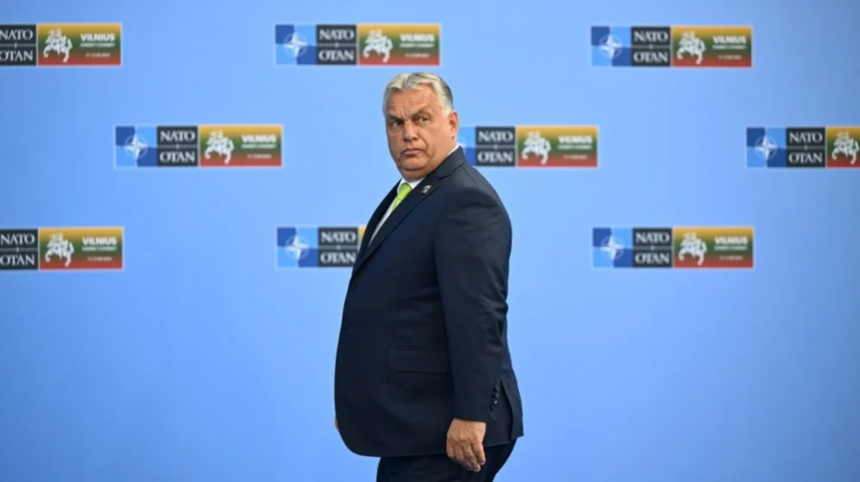
Hungary has entered a new political era after opposition leader Peter Magyar secured a decisive victory in the country’s parliamentary elections, ending the 16-year rule of Prime Minister Viktor Orbán.
Orbán, who had led the country since 2010 and was seeking a sixth consecutive term, acknowledged defeat, describing the outcome as “clear and painful” for his party. He nevertheless pledged to continue serving Hungary from the opposition.
Magyar, leader of the Tisza Party, thanked voters for their support, calling the result a turning point in Hungary’s political trajectory.
Who is Peter Magyar?
Peter Magyar is a relatively new figure in national politics, having entered the political scene just two years ago following a domestic political crisis involving his former spouse, a former justice minister in Orbán’s government.
In early 2024, Magyar broke away from the ruling establishment, accusing it of corruption. He subsequently took leadership of the center-right, pro-European Tisza Party, positioning it as a reform-oriented alternative.
His rise was rapid. In the 2024 European elections, the party secured around 30% of the vote, emerging as the second-largest political force behind Orbán’s Fidesz.
Preliminary Results and Voter Turnout
With more than 90% of votes counted, Magyar’s party is projected to win approximately 138–139 seats in the 199-member parliament. In contrast, the ruling Fidesz–KDNP alliance is expected to secure around 53–55 seats.
Hungary’s mixed electoral system allocates 93 seats proportionally, while 106 are decided in individual constituencies—often playing a decisive role in forming a parliamentary majority.
Voter turnout reached 77.8%, marking the highest participation rate since 2002.
Campaign Dynamics and Political Context
The election campaign was closely watched by international actors including the European Union, the United States, Ukraine, and Russia, amid mutual accusations of foreign interference.
Magyar campaigned on promises to combat corruption, strengthen ties with the European Union, and improve public services. He framed the election as an opportunity for Hungarians to “take back their country.”
Meanwhile, Viktor Orbán focused on national sovereignty and stability, warning of political risks and emphasizing geopolitical tensions, particularly regarding Ukraine, which he frequently described as a hostile state during the campaign.
A Defining Election for Hungary
These elections are widely regarded as among the most consequential in Hungary in recent decades, with significant implications for the country’s future direction—particularly its relationship with the European Union and its broader foreign policy orientation.
The shift in power signals a potential recalibration of Hungary’s domestic governance and international alignment after more than a decade of Orbán’s leadership.