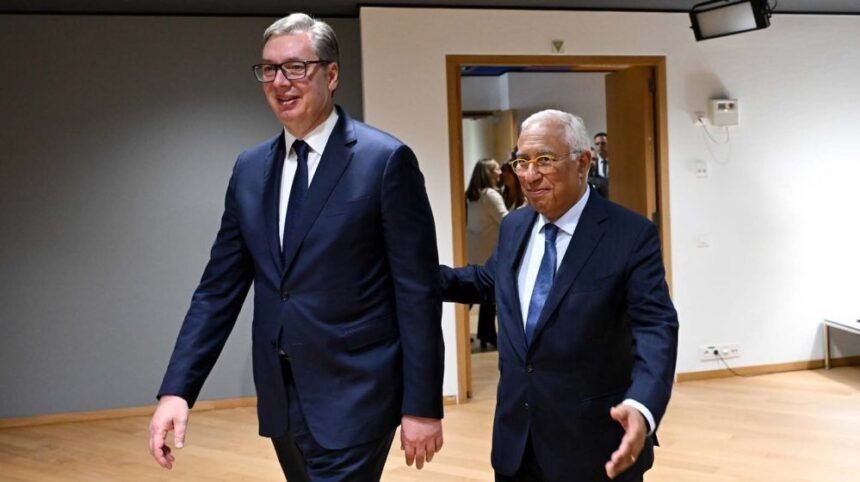
Serbian President Aleksandar Vučić’s decision that Serbia will have no representation at the EU–Western Balkans Summit in Brussels—the first time in 14 years—signals, according to experts cited by Danas, a collapse of the so-called “illusion of European integration” under the current regime. Observers describe it as an impulsive reaction of a leader who equates himself with the state, acting as if the EU should adjust to Serbia, not vice versa.
The announcement came last-minute on Tuesday evening, when Vučić spoke on RTS, stating:
“For the first time in the past 13 or 14 years, neither I nor anyone else will attend this intergovernmental conference. No one will represent the Republic of Serbia, so the Western Balkans will be without the Republic of Serbia.”
He justified the move as being in defense of Serbia and its citizens, despite anticipated criticism from Brussels:
“I believe this protects Serbia and its interests. Serbia is on its own side, no matter how Washington, Brussels, or Moscow feel about it. We will remain on the European path as long as I am president.”
The reasons for this impulsive decision remain unclear, with speculation ranging from frustration over EU criticism and the slow opening of Cluster 3, to envy of Montenegro, which has opened five chapters and is promised EU membership by late 2026.
Some see Vučić as used to being praised by European officials, but recent recognition has gone to Montenegro’s Prime Minister Milojko Spajić instead. Meanwhile, Minister for European Integration Nemanja Starović attempted to justify the decision as a demonstration of Serbia’s commitment to EU membership, while EU officials have expressed regret but acknowledged it as the president’s choice.
Analysis and Criticism
- Mijat Kostić, researcher at Novi treći put, notes that the lack of a clear explanation leaves the EU with multiple interpretations. He emphasizes that EU institutions distinguish between current government decisions and long-term citizen interests, and continue to encourage Serbia to accelerate reforms, especially in rule of law, institutional independence, and media freedom.
- Borko Stefanović, MP and deputy head of the Freedom and Justice Party (SSP), argues that Vučić is angry at Europe because the regime cannot tolerate justified criticism regarding corruption, electoral theft, media suppression, and attacks on the judiciary. Stefanović describes Vučić as still in “hotel shock” after rebukes from the U.S., acting as if the EU should submit to Serbia.
- Marko Vujičić, international secretary of the Green-Left Front, calls the decision a sign of the final collapse of the “four pillars” policy and Serbia’s attempt to play multiple sides, noting that the government misleads the EU while the president insults EU representatives. He stresses that true European engagement requires reforms and institution-building, not avoidance or theatrics.
- Ksenija Marković, international secretary of the Democratic Party, describes the decision as reducing EU integration to a political spectacle, undermining Serbia’s credibility, and leaving empty chairs where important regional decisions are made.
In sum, observers portray Vučić’s move as impulsive, self-centered, and damaging to Serbia’s EU credibility, reflecting a broader domestic and foreign policy crisis.