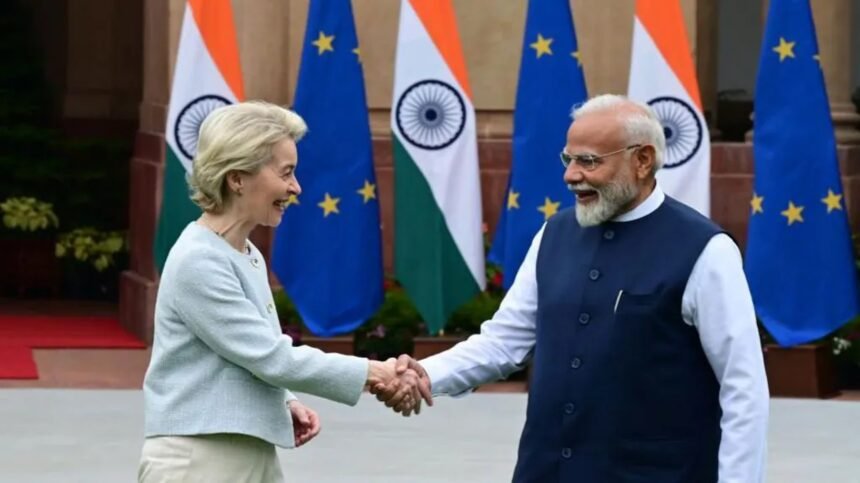
The President of the European Council, António Luís Santos da Costa, and the President of the European Commission, Ursula von der Leyen, will be the main guests at India’s Republic Day celebrations next Monday.
Beyond the state banquets and ceremonial pomp, both leaders have a far more pressing item on their agenda: advancing free trade negotiations with Asia’s third-largest economy.
This comes at a particularly challenging geopolitical moment for Europe, as President Donald Trump initially threatened to escalate a trade war with European allies—amid U.S. efforts to assert control over Greenland—before later pulling back.
The choice of guests also carries a significant diplomatic message from India: New Delhi is accelerating its strategic and trade ties with the rest of the world as the deadlock over the United States’ 50% tariffs on Indian goods continues into the new year.
“This sends a signal that India is pursuing a diversified foreign policy… and is not subject to the whims of the Trump administration,” Chietigj Bajpaee of the London-based think tank Chatham House told the BBC.
Several reports suggest the agreement could be announced as early as 27 January, when leaders from both sides are set to meet for a high-level summit. Both von der Leyen and India’s Commerce Minister, Piyush Goyal, have described the deal as the “mother of all agreements,” highlighting the importance attached to concluding negotiations that have lasted nearly two decades.
If finalized, this would be India’s ninth free trade agreement in four years, following deals with the United Kingdom, Oman, New Zealand and others. For Brussels, it would follow the recently concluded agreement with the Mercosur trade bloc, as well as agreements with Japan, South Korea and Vietnam.
“Both sides are now seeking reliable trade partners, as geopolitical threats have created a turbulent environment for global trade. The demand is equally strong—India wants to mitigate problems arising from U.S. tariffs, while the EU seeks to reduce its dependence on China, which it views as unreliable,” said Sumedha Dasgupta, a senior analyst at the Economist Intelligence Unit.
The agreement also marks a “sustained and significant effort to dismantle India’s well-known protectionist barriers,” Dasgupta added.