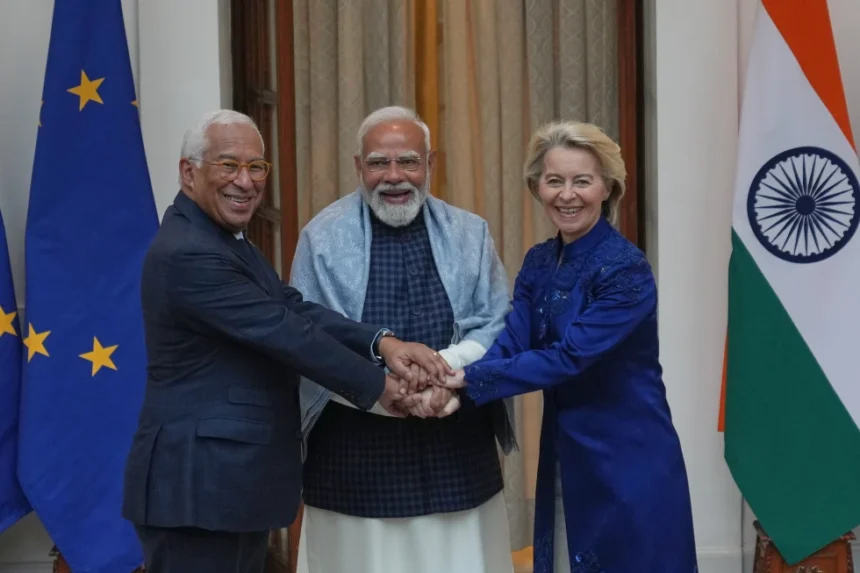
India and the European Union have reached a historic free trade agreement, Prime Minister Narendra Modi announced on Tuesday, marking one of the largest bilateral trade deals in the world and concluding nearly two decades of negotiations.
Often described by both sides as the “mother of all deals,” the agreement covers economies representing around 2 billion people, 25% of global GDP, and one-third of global trade. Modi said the deal will significantly deepen economic and strategic ties between India and the EU.
“This agreement will bring major opportunities for the people of India and Europe,” Modi said while addressing an international energy conference virtually.
The announcement comes at a time of growing global trade tensions, as the United States has imposed steep tariffs on both India and the EU, disrupting established trade flows and pushing major economies to seek alternative partnerships.
Modi was expected to jointly announce the agreement later Tuesday alongside European Commission President Ursula von der Leyen, who is visiting India as part of the EU’s broader push to strengthen ties beyond the transatlantic relationship.
Strategic and Economic Impact
The deal gives the EU expanded access to one of the world’s fastest-growing major economies, helping European exporters and investors reduce dependence on volatile markets. At the same time, India aims to diversify its export destinations to offset the impact of higher U.S. tariffs.
Bilateral trade between India and the EU reached $136.5 billion in 2024–25, and officials hope to increase that figure to nearly $200 billion by 2030.
According to Indian trade analyst Ajay Srivastava, the agreement is about “creating a stable commercial corridor between two major markets at a time when the global trading system is fragmenting.”
Geopolitical Context
The EU has accelerated outreach to global partners amid strained relations with Washington, driven by higher U.S. tariffs, political friction, and uncertainty over long-term alliances. Under the banner of “strategic autonomy,” Brussels has recently finalized trade deals with Japan, Indonesia, Mexico, and South American partners.
“We are showing a fractured world that another way is possible,” von der Leyen wrote on X after arriving in India.