Renewed anti-government protests across Iran are highlighting the Islamic Republic’s growing vulnerability, driven by deep economic hardship and political frustration. However, a former senior UN official cautions that regime collapse remains far from certain.
According to Guido Ambroso, former UNHCR representative in Azerbaijan, Iran’s leadership has been significantly weakened by its failure to defend against Israeli and U.S. airstrikes in June 2025, a development that has emboldened protesters nationwide.
Economic Crisis Fuels Political Unrest
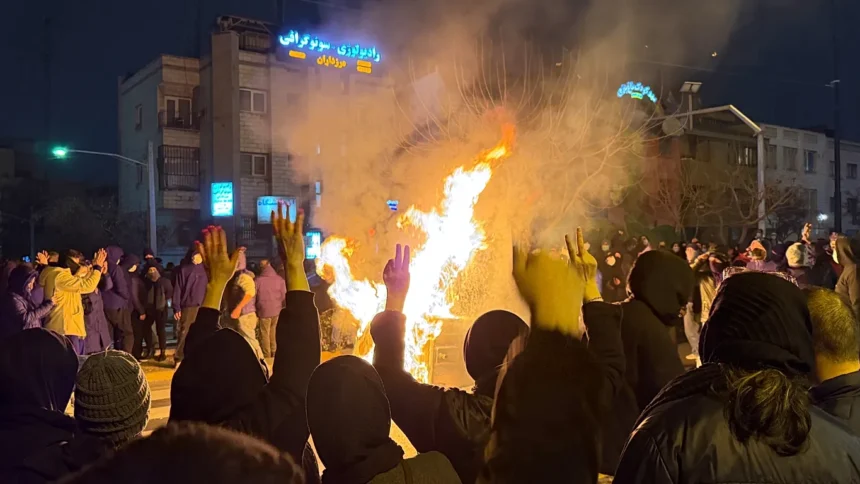
Demonstrations have spread to multiple Iranian cities, accompanied by reports of fatalities, mass arrests, communication blackouts, and violent repression by security forces. Human rights organisations have documented thousands of casualties, arbitrary detentions, and house-to-house arrests.
The unrest reflects years of inflation, currency collapse, and rising unemployment, which have severely eroded living standards and expanded dissatisfaction well beyond traditionally marginalised groups.
Ambroso noted that declining purchasing power now affects broad sections of society, including groups that historically supported the authorities. He highlighted a highly educated, globally connected population that increasingly feels excluded from political participation and public life.
International Concern and Human Rights Warnings
UN High Commissioner for Human Rights Volker Türk has urged Iranian authorities to end violence against peaceful protesters and respect fundamental freedoms. Restrictions on civil liberties, cultural expression, and political rights, particularly among urban youth and professionals, have intensified public anger.
While the protest movement was initially self-reinforcing, Ambroso said it has lost momentum under sustained repression and the absence of meaningful external support.
Regime Survival Still Possible
Despite the regime’s weakened position, Ambroso warned against assuming its imminent collapse, stressing that Iran’s strong institutional structures may allow it to withstand pressure longer than other regional governments.
He cautioned that a potential regime downfall — which is “not at all guaranteed” — would have far-reaching consequences for neighbouring countries, including Turkey, Azerbaijan, Iraq, Armenia, as well as parts of Central Asia and the Gulf.
Regional Impact and Refugee Concerns
Heightened security and trade disruptions have already been reported. Turkey has recorded a limited rise in arrivals, including Iranians, foreign nationals, and diplomatic families. Ambroso praised Turkey for keeping its borders open, despite hosting millions of refugees, particularly Syrians.
He warned that a sharper escalation could trigger wider displacement, potentially affecting Iraq’s Kurdish region, Tajikistan, and Afghanistan, due to ethnic and linguistic ties.
Two Possible Futures for Iran
Ambroso outlined two potential scenarios:
- Containment through repression and limited concessions, restoring short-term stability but leaving Iran weakened domestically and internationally.
- A less likely political transition toward a more open system, which would significantly reshape regional geopolitics and complicate relations with Russia and China.
He urged countries to keep borders open and provide protection to those fleeing persecution, recalling that Iran hosted over one million Iraqi-Kurdish refugees in 1991 and currently shelters more than 700,000 Afghan refugees.
“Now it is time to show generosity toward Iranians seeking international protection,” Ambroso said, adding that most would return home once basic freedoms and democracy are restored.