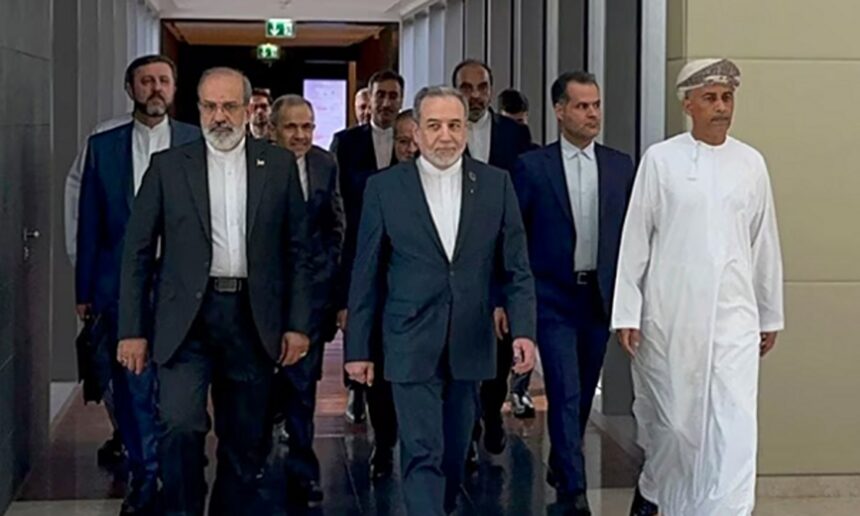
Iran’s foreign minister said Tehran and Washington believe nuclear talks should resume soon following indirect negotiations in Oman, although Tehran ruled out discussions on its missile program and uranium enrichment.
Abbas Araqchi told Qatar’s Al Jazeera television on February 7 that both sides agreed talks should restart in the near future, adding that no deadline has been set for the next meeting.
While saying Tehran is open to reaching an agreement, Araqchi stressed that issues related to Iran’s missile program and uranium enrichment are unacceptable topics for future negotiations.
“Neither now nor in the future can negotiations be held on missiles, because this is a defensive issue,” he said. “The issue of stopping enrichment is not negotiable from Iran’s point of view.”
Araqchi added that Iran would respond to any potential U.S. attack: “If Iran is attacked, we will target U.S. bases in the region.”
His comments came a day after delegations from Tehran and Washington held Oman-mediated talks, and after U.S. President Donald Trump said the discussions were “very good.”
While neither side announced concrete results, both suggested that negotiations over Iran’s nuclear program could continue soon.
“Iran seems to want very much to reach a deal. We have to see what kind of deal it is,” Trump told reporters aboard Air Force One.
“The fact that the talks did not fail and that neither side walked away from the negotiating table suggests they may have found enough common ground, or that both sides put forward concessions attractive enough to continue the talks,” Ali Vaez, Iran Project Director at the International Crisis Group, told Radio Farda of RFE/RL.
The talks took place amid a U.S. military buildup in the Middle East. Tensions have been heightened by more than two weeks of unrest in Iran, during which authorities launched a harsh crackdown that human rights groups say killed thousands of civilians.
As reports of the crackdown emerged, Trump threatened to strike Iran if any of the tens of thousands of arrested protesters were executed.
The U.S. president has kept military options on the table while emphasizing efforts to curb Iran’s nuclear program, which Western powers fear aims to produce a bomb, despite Tehran’s insistence that it is for civilian purposes.
After the Oman talks, the U.S. State Department announced new sanctions on Iran’s oil exports, targeting 15 entities and 14 vessels linked to the so-called “shadow fleet.”
“The United States will continue to act against networks of shippers and traders involved in the transport and purchase of Iranian crude oil, petroleum products, and petrochemicals,” State Department spokesman Tommy Pigott said in a statement.
Separately, Trump signed an executive order that could impose secondary tariffs on countries importing goods from Iran, according to a White House statement.
The order describes the move as “necessary and appropriate” after receiving additional information from senior officials about the “actions and policies” of the Iranian government.
Trump has not commented directly on the order but reiterated “no nuclear weapon” for Iran while speaking to reporters aboard Air Force One.
The order does not specify the tariff level but cites 25 percent as an example, saying it could apply to goods imported into the U.S. from any country that “directly or indirectly purchases, imports, or otherwise acquires any goods or services from Iran.”
The White House said the latest executive order reaffirms the “ongoing national emergency with respect to Iran” and noted that the president could modify it if circumstances change.
“The President is holding Iran accountable for pursuing nuclear capabilities, supporting terrorism, developing ballistic missiles, and engaging in regional destabilization that threatens U.S. security, allies, and interests,” the order states. /RFE/RL/