Serbia’s ruling Serbian Progressive Party (SNS) is unlikely to leave the European People’s Party (EPP) on its own initiative, despite increasingly strained relations, political analysts told Danas. According to them, SNS would only exit the EPP under direct pressure or if the group itself moves to sever ties.
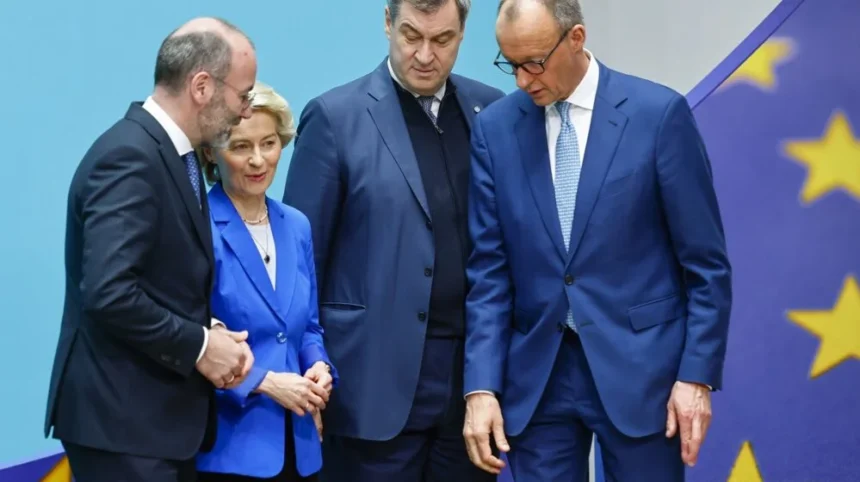
The EPP, the largest political family in Europe, includes German Chancellor Friedrich Merz and European Commission President Ursula von der Leyen. SNS has held associate membership since 2016, benefiting politically from its affiliation with Europe’s dominant center-right bloc.
Relations Under Strain After Protests and Police Violence
Despite years of cooperation, criticism of the EPP’s relationship with SNS has grown, particularly amid accusations that European support has contributed to so-called “stabilocracy” in Serbia.
Tensions escalated following the deadly collapse of a railway station canopy, which triggered mass civic protests and violent reactions by police and state authorities. In response, Manfred Weber, leader of the EPP group in the European Parliament, announced last autumn that SNS’s future within the EPP would be reviewed.
Although an internal assessment process has reportedly begun, its outcome remains unclear.
“A Shame to Have SNS in Their Ranks”
Vladimir Prebilič, a Green Party MEP who participated in a European Parliament mission to Serbia alongside EPP members, said that even EPP representatives themselves recognize the reputational damage.
“It is a shame to have the SNS in their ranks,” Prebilič told Danas.
“The only question is whether they will find the strength to push them out, because the EPP rarely expels anyone. Even Viktor Orbán left on his own.”
Prebilič added that a similar fate may soon await President Aleksandar Vučić and the SNS.
SNS Will Not Leave Unless Forced
Nikola Burazer, program director at the Center for Contemporary Politics, said SNS has no incentive to leave voluntarily.
“SNS has gained significant benefits from its EPP affiliation over the years,” Burazer noted.
“Even amid cooling relations, it remains important for the party to keep at least some allies within the EPP.”
He recalled that Hungarian Prime Minister Viktor Orbán and his Fidesz party exited the EPP only after it became clear they would be expelled.
Complex Procedures Make Expulsion Difficult
According to Miloš Pavković, Director of Strategy at the Center for European Policy, internal EPP procedures are highly complex, requiring an absolute — and in some cases qualified — majority of EPP members in the European Parliament to expel a party.
“SNS likely still maintains close ties with several conservative parties within the EPP,” Pavković said.
“At this moment, there is probably no necessary majority for its exclusion.”
However, he acknowledged that if a formal membership review process begins, SNS could preemptively withdraw, mirroring the Fidesz scenario.
EPP Unlikely to Act Soon
Vladimir Međak, Vice President of the European Movement in Serbia, said that SNS is not currently on the verge of expulsion.
“SNS will never leave the EPP unless it has to,” Međak stated.
“And I do not believe the EPP will expel SNS.”
Following earlier announcements about discussions over SNS’s status, senior SNS officials, including Ana Brnabić and President Aleksandar Vučić, expressed optimism. However, no clear explanation of SNS’s standing emerged after their October meeting with EPP representatives in Brussels.
EPP Meeting in Zagreb
The European People’s Party is holding a major international meeting in Zagreb this Friday and Saturday, where leaders of member parties will set key political priorities for the coming year. It remains unclear whether the status of SNS will be addressed publicly during the gathering.