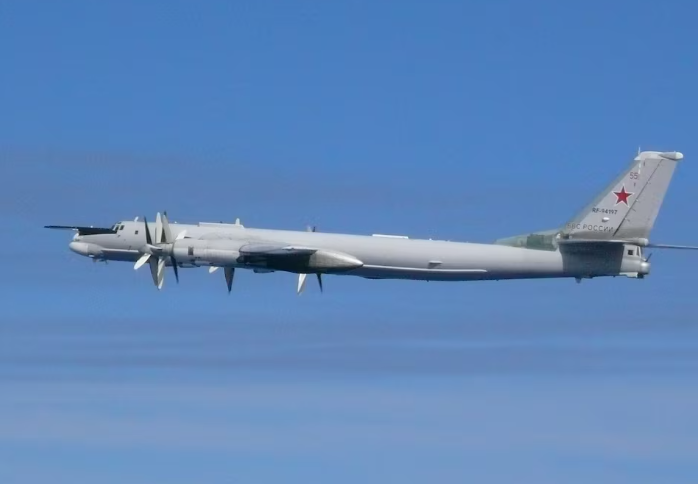
Japan has deployed fighter jets to monitor Russian and Chinese military aircraft conducting joint patrols near its airspace, the country’s Ministry of Defense confirmed on Monday evening (9 December). The move comes amid mounting tensions between Tokyo and Beijing.
According to the ministry, two Russian Tu-95 strategic bombers, capable of carrying nuclear weapons, flew from the Sea of Japan toward the East China Sea, where they were joined by two Chinese H-6 bombers for an extended patrol over the Pacific Ocean.
As the formation continued through the air corridor between the Japanese islands of Okinawa and Miyako, an area considered international airspace, it was reinforced by four Chinese J-16 fighter jets.
Japan also reported additional Russian air activity, identifying an A-50 early-warning aircraft and two Su-30 fighter jets operating over the Sea of Japan.
Japanese Defense Minister Shinjiro Koizumi stated on X that the joint Russian–Chinese operation “clearly aimed to demonstrate force against our country, representing a serious concern for national security.” He added that Japan’s Air Self-Defense Force responded according to strict air-defense identification procedures.
Russian state media reported that the joint patrol lasted eight hours, citing the country’s Ministry of Defense. Meanwhile, South Korea’s military said that seven Russian and two Chinese aircraft entered its air defense identification zone on Tuesday.
The tensions follow Japan’s accusation on Sunday that Chinese fighter jets launched from an aircraft carrier had targeted their radar systems toward Japanese aircraft — a claim China denied.
This escalation comes shortly after Japanese Prime Minister Sanae Takaichi warned that Japan could respond to any Chinese military action against Taiwan that threatens Japan’s security.
In recent years, China and Russia have significantly deepened their military cooperation, conducting joint exercises and operations, including missile-defense drills in Russia and live-fire naval maneuvers in the South China Sea.