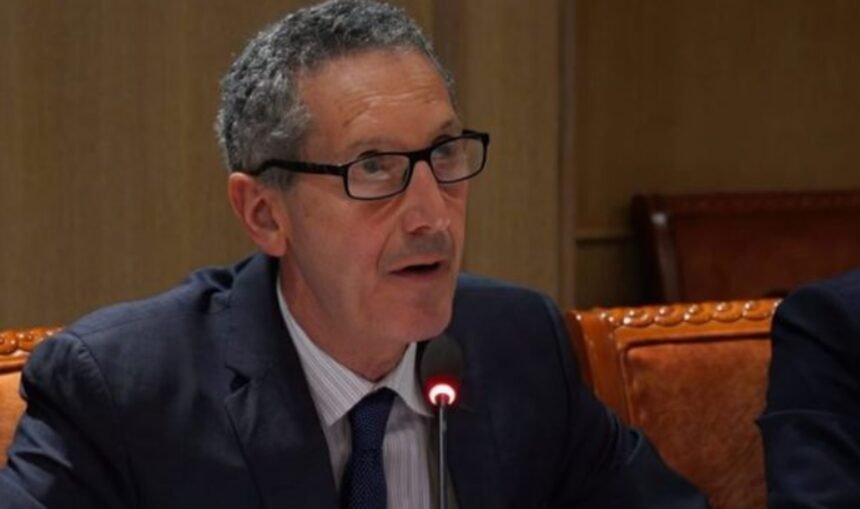
Edward P. Joseph, a lecturer at Johns Hopkins University in the U.S. and an expert in conflict management, has proposed a strategic approach to achieving peace in Ukraine based on the Kosovo model.
He outlined this idea in an analysis published in the academic journal SAIS Review of International Affairs.
Speaking to Radio Free Europe/Radio Liberty, Joseph explained that applying the principles of UN Security Council Resolution 1244 in Donbas—international administration, deployment of peacekeeping forces, and postponing the sovereignty issue—could provide security guarantees for Ukraine without requiring acceptance of Russian annexation of the region.
Joseph also praised the efforts of the Trump administration, noting that it focused on achieving peace in Ukraine and introduced new dynamics into the negotiation process.
Radio Evropa e Lirë: You propose applying the Kosovo model to Donbas. What is the most important lesson from Kosovo that you believe could be applied to Ukraine today?
Edward P. Joseph: The most important and interesting aspect of using the Kosovo model in Donbas is that Russian President Vladimir Putin supports it.
This is a starting point, but not the only one. For over two decades, Putin has insisted that Resolution 1244 must be respected. [This 1999 resolution ordered the withdrawal of the Federal Republic of Yugoslavia’s forces from Kosovo and placed the territory under UN administration.]
Putin has also repeatedly stated that Kosovo and Ukraine are comparable.
The idea of using a model is entirely appropriate. The U.S. administration is also taking elements from the Gaza plan, but I believe the Kosovo model is far more relevant than Gaza. Putin himself understands this model very well.
RFE/RL: Critics argue that Kosovo was a unique case, with strong international consensus, unlike Ukraine. Why do you believe such a model could still work?
Joseph: Resolution 1244 removed the issue of sovereignty from immediate discussion without denying or declaring Kosovo’s independence, ending the conflict and opening the door to international administration and peacekeeping forces in Kosovo.
The same principle could apply in Donbas, postponing the debate over “whose territory” it is to a later date—with a future referendum to resolve it. Putin supports referendums; he organized them in Crimea and in parts of Donbas under Russian control. So he would be presented with two things he cannot oppose: the 1244 model and a referendum.
Using this model, Russia could potentially gain even more territory than the Trump plan offers, including western Donbas, which is sensitive for Ukraine. Control over these areas would give Russia direct influence over the entire country and even open a path toward Kyiv.
However, Russia would need to accept one condition, similar to Kosovo: administration of Donbas by a third party, either the UN or the OSCE.
Russia, as a permanent member of the UN Security Council, may favor UN administration, given its repeated insistence that UNMIK remain in Kosovo.
RFE/RL: Do you think Ukraine would accept such a plan?
Joseph: It would be favorable for Ukraine. First, Kyiv would not have to recognize Russian annexation of Donbas. Second, Crimea’s status could be left for later negotiations, as military recovery is highly unlikely.
Most importantly for President Volodymyr Zelensky, there would be security guarantees. The Kosovo model would provide international administration through the UN or OSCE, immediately preventing Russian-imposed passports, military indoctrination of children, and obstacles for displaced residents returning home.
International commissions would also manage property rights.
Peacekeeping forces would be deployed in Donbas, similar to Kosovo, and to make them acceptable to Russia, these forces could come from Africa or Asia, not necessarily Europe.
The essence of this approach is that temporarily setting aside sovereignty makes all other elements far easier to negotiate.
RFE/RL: Have you discussed this idea with any U.S. officials or official sources?
Joseph: That is a very good question, but I cannot confirm having had such discussions, because it would prompt the question: with whom? I can only say it would be entirely logical and natural for me to discuss this with American officials.
For example, the decision to publicly rule out providing Ukraine with Tomahawk missiles. If the U.S. doesn’t want to provide them, fine—but why announce it publicly? These could serve as leverage, signaling to Putin that if he pushes too hard, U.S. support for Ukraine could expand further.
RFE/RL: You also argue that Serbia joining NATO could be a strategic gain for Ukraine. How realistic is this, given Serbia’s domestic politics and strong pro-Russian sentiment?
Joseph: It would put additional pressure on Putin. Strategically, it would be equivalent to sinking the Russian warship Moskva—a symbolic and practical blow. Serbia is Russia’s “Moskva” in the Balkans: the vessel through which Russia projects influence across the region.
If Serbia’s NATO accession is realized, it would weaken Russian influence, and also China’s, as both formally and symbolically view Serbia as a key strategic partner and platform in the Balkans.
You may ask why Serbia would do this given its pro-Russian sentiments. There are several reasons, including one that makes it nearly impossible for President Aleksandar Vučić to refuse a Trump offer. Trump is extremely popular in Serbia and commands immense influence. It would be politically very difficult for Vučić to reject him.
Trump also previously attempted to broker peace between Kosovo and Serbia—so this would not be a new initiative. Serbia is politically isolated: three of the six Western Balkan states are in NATO. Serbia is the only state refusing membership, while Bosnia has expressed formal interest, and Kosovo strongly desires NATO membership.
Serbia also has good relations with NATO, including the U.S. military. Privately, most Serbian generals would favor NATO accession, as it would strengthen Serbia’s defense industry.
Trump’s plan could also pave a NATO path for Kosovo. The Kosovar prime minister would need to sign the statute for the Association of Serb-Majority Municipalities, which Vučić has long sought.
Even though four NATO members do not recognize Kosovo (Greece, Romania, Slovakia, Spain), they would not need to block NATO access. Within three years, tensions could decrease, trade could grow, and relations would improve significantly.