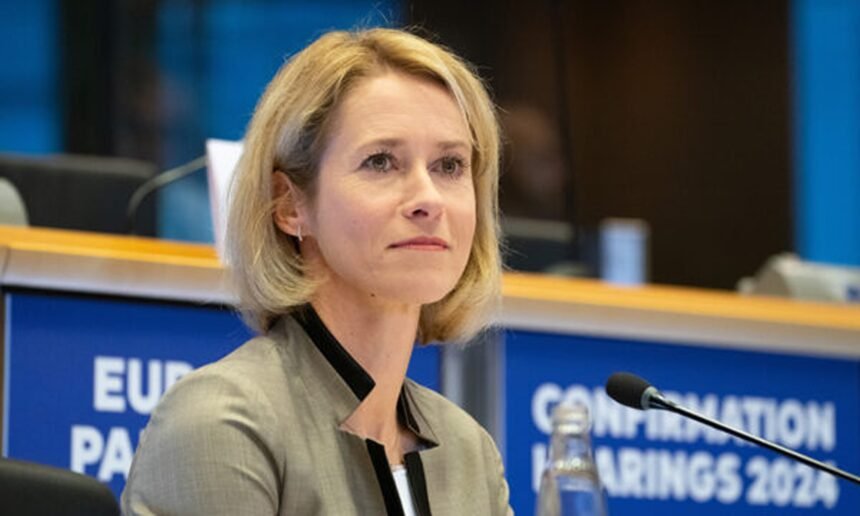
The European Union’s High Representative for Foreign Affairs and Security Policy, Kaja Kallas, stated that Russia is no longer a superpower, noting that it has struggled to make significant progress on the battlefield compared to 2014. She described EU enlargement as the antidote to what she called “Russian imperialism.”
“Today, Russia is weakened, its economy is in serious condition, it is cut off from the European energy market, and its citizens are leaving. The biggest threat is that it could gain more at the negotiating table than on the battlefield,” Kallas said. She warned that “Russia’s maximalist demands cannot be met with a minimal response.”
She also outlined the EU’s principles for achieving peace in Ukraine:
- If Ukraine’s army is restricted, Russia’s army must also be restricted.
- Russia must pay for war damages.
- There can be no amnesty for war crimes.
- The return of abducted Ukrainian children must be ensured.
“This is the minimum if peace is truly Russia’s goal. Since we doubt that it is, Europe is rearming together with its partners,” she said.
Kallas warned that the occupation of Donbas is not Russia’s final objective. According to her, Moscow aims to weaken economies through cyberattacks, interference with satellites, sabotage of underwater cables, destruction of alliances through disinformation, using energy as a pressure tool, and nuclear threats.
She stressed that the EU must ensure stability in its eastern and southern neighborhoods, adding that enlargement is a geopolitical choice the bloc must support.
Kallas emphasized that the European Union remains an attractive forum and that the “waiting list” for membership continues to grow.
“Citizens still want to join our bloc, and not only Europeans. When I was in Canada last year, I was told that more than 40 percent of Canadians are interested in joining the EU. I just hope that those who have been waiting for a long time won’t have to wait even longer,” she said during her speech at the Munich Security Conference, rejecting claims that Europe is facing civilizational decline.
When asked about the possibility of fast-tracking Ukraine’s EU membership, she admitted there is still no clear positive answer. The idea of accelerated membership would allow Ukraine to join earlier with certain limitations, including voting rights, while full membership would require meeting all standards and unanimous approval from member states.
Kallas said this approach would not discourage long-waiting countries, particularly in the Western Balkans.
“We [in Estonia] also had to implement many reforms to join the EU, but the geopolitical situation was decisive. It may not be realistic to say everyone should join at the same time, because there are small countries like Montenegro and Albania that have been waiting for a long time and are actively working on reforms. If we want change, we need to make decisions faster. It cannot be that candidates do their homework, and then we tell them we are not ready to accept them,” Kallas said in Munich.
The Munich Security Conference concluded on February 15 after a three-day session. It is one of the most important geopolitical gatherings in the world, bringing together leaders and senior officials. Organizers said this year’s edition was the largest so far, with more than 1,000 delegates, including around 50 prime ministers and foreign ministers. The conference took place amid global tensions, including the war in Ukraine, tensions surrounding Iran, and discussions about the future of NATO and the transatlantic alliance.