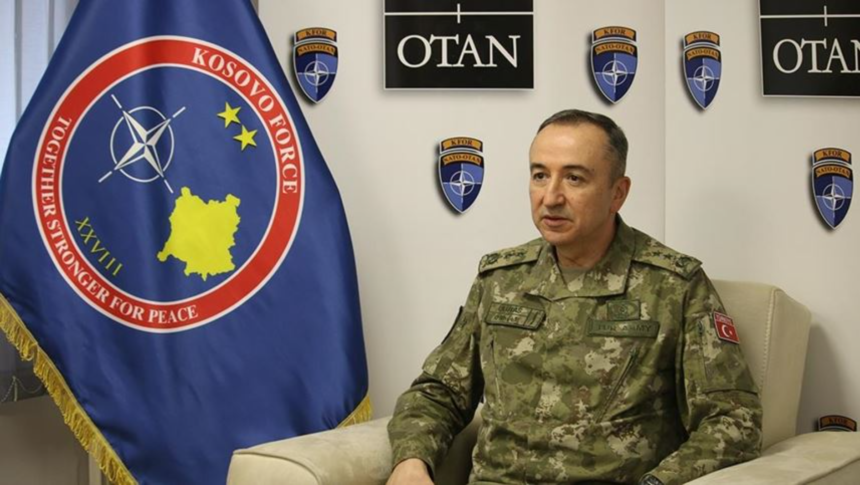
The Commander of the NATO-led peacekeeping force in Kosovo (KFOR), Major General Özkan Ulutaş, stated that NATO continues to demand accountability for the Banjska incident and that those responsible must be brought to justice.
In an interview with RTV21, General Ulutaş said KFOR was not involved in any alleged negotiations to facilitate the withdrawal of the armed group that attacked Kosovo Police in Banjska in 2023. Instead, KFOR’s role was to restore security in the area. He also confirmed that KFOR will maintain its permanent presence at the main bridge over the Ibar River and continue regular patrols in surrounding areas for as long as necessary. He further clarified that the Kosovo Security Force (KSF) cannot deploy to northern Kosovo without prior approval from the KFOR Commander.
Accountability for Banjska
General Ulutaş emphasized that KFOR operates under UN Security Council Resolution 1244 (1999) and does not have a law enforcement mandate. However, NATO remains concerned about the escalation of violence in 2023 and has consistently called for accountability. He noted that NATO Secretary General Mark Rutte recently reiterated this demand and that NATO expects Serbian authorities to play their role in ensuring justice.
KFOR, he stressed, was never involved in negotiations to allow the attackers to leave Kosovo. Instead, the mission reinforced its presence with approximately 1,000 additional troops — the largest reinforcement in a decade — and coordinated closely with the Kosovo Police and the EU Rule of Law Mission (EULEX) to stabilize the situation.
Security Situation in Northern Kosovo
According to the KFOR Commander, the overall security situation in Kosovo is relatively calm but remains fragile due to unresolved issues, inflammatory rhetoric, and disinformation. While there are no signs of imminent conflict, the continued discovery of weapons and ammunition in northern Kosovo is a cause for concern.
KFOR maintains a visible and flexible presence across Kosovo, particularly at the main bridge over the Ibar River in Mitrovica. Ulutaş stressed that any immediate and uncoordinated actions, especially in the north, risk escalating tensions and undermining security.
He reiterated NATO’s strong support for the EU-facilitated dialogue between Pristina and Belgrade, describing it as the only sustainable framework for resolving outstanding issues and ensuring long-term stability.
On the Kosovo Security Force (KSF)
Ulutaş confirmed that, under existing agreements, the Kosovo Security Force may deploy to northern Kosovo only with prior authorization from the KFOR Commander. He welcomed Kosovo’s continued adherence to these arrangements.
Regarding Kosovo’s efforts to strengthen its defense capabilities — including arms procurement and trilateral cooperation with Albania and Croatia — Ulutaş noted that NATO as an organization is not a party to those agreements, though NATO allies are free to pursue bilateral or trilateral cooperation.
No Planned Reduction of U.S. Troops
Addressing reports of a potential reduction of U.S. troops in KFOR, General Ulutaş stated that force posture is regularly reviewed, but there are currently no significant changes under consideration.
He highlighted that the United States continues to play a fundamental role in supporting sustainable security in Kosovo and regional stability. Nearly 600 U.S. troops are currently deployed within KFOR, leading the Regional Command East and contributing to daily operations, patrols, training exercises, community engagement, and reconstruction initiatives.