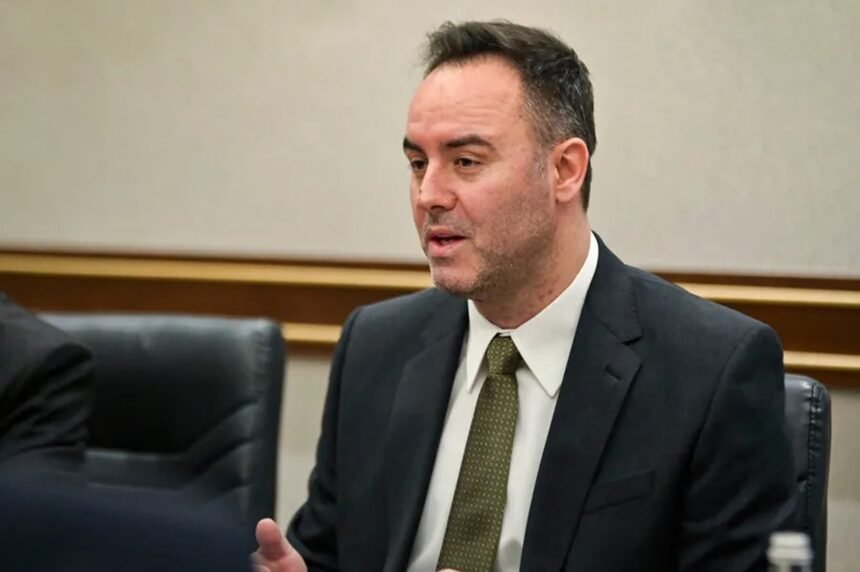
Kosovo’s Acting Minister of Foreign Affairs, Glauk Konjufca, has responded to Ukrainian President Volodymyr Zelenskyy’s statement made a day earlier in Belgrade.
He expressed regret over Ukraine’s reaffirmation that it does not recognize the Republic of Kosovo, emphasizing that Kosovo has stood unequivocally alongside Ukraine, imposed sanctions against Russia and Belarus, provided humanitarian assistance and accommodation for Ukrainian journalists, and offered military assistance and training in support of Ukraine’s defense.
“We regret the comments made by President Zelenskyy in Belgrade, which reaffirm Ukraine’s non-recognition of the Republic of Kosovo. From the first day of Russia’s full-scale aggression, Kosovo has stood unequivocally alongside Ukraine. We condemned the invasion, fully aligned with the Foreign and Security Policy, imposed sanctions against Russia and Belarus, provided humanitarian assistance and accommodation for Ukrainian journalists, and contributed military assistance and training in support of Ukraine’s defense. We did this despite Ukraine’s non-recognition of our state, because solidarity with a people defending its freedom, sovereignty, and territorial integrity is a matter of principle. It is equally important to recall a clear distinction: while Kosovo has imposed sanctions against Russia, Serbia is not aligned with the EU sanctions imposed in response to Russia’s war of aggression against Ukraine,” Konjufca wrote.
He recalled that the Republic of Kosovo is a sovereign and independent state, born from its people’s struggle for freedom and their liberation in 1999, following years of systematic repression and the genocidal campaign of the Milošević regime.
Konjufca said that what followed was not an act of annexation, occupation, or territorial conquest, but an extensive international process under United Nations administration and years of internationally mediated negotiations over Kosovo’s final status.
“When these negotiations had exhausted every possibility for an agreed solution, UN Special Envoy Martti Ahtisaari recommended independence as Kosovo’s final status and presented a comprehensive framework for the new state, including some of the broadest constitutional guarantees for non-majority communities in Europe. Kosovo declared its independence on February 17, 2008, as the culmination of this political and historical process, assumed its responsibilities as a democratic and multiethnic state, and entered a period of internationally supervised independence. In 2010, the International Court of Justice confirmed that Kosovo’s declaration of independence did not violate international law, while international supervision officially ended in 2012.”
In this context, Konjufca noted that today the Republic of Kosovo is recognized by the overwhelming majority of NATO and EU member states and has firmly built its statehood on the principles of democracy, human rights, peace, and Euro-Atlantic integration.
“For precisely these reasons, Russia’s attempts to invoke Kosovo as a precedent or justification for its invasion, occupation, or efforts to annex Ukrainian territory are historically and legally false. There is no such parallel. Kosovo remains unwavering in its support for Ukraine’s sovereignty, independence, and territorial integrity. At the same time, we respectfully but firmly reject any characterization of the Republic of Kosovo through the prism of Serbia’s territorial integrity. We would welcome Ukraine’s recognition of the Republic of Kosovo. Such a decision would strengthen the very principles of freedom, democracy, and international law that Ukraine itself is defending today,” Konjufca added.
A day earlier, Ukrainian President Volodymyr Zelenskyy said that Ukraine’s policy regarding its non-recognition of Kosovo’s independence had not changed.
“We respect the territorial integrity of our partners and international law. Regarding Kosovo, our position remains unchanged. We are grateful to Serbia for respecting Ukraine’s territorial integrity, including Crimea,” Zelenskyy said during a press conference in Belgrade alongside Serbian President Aleksandar Vučić.