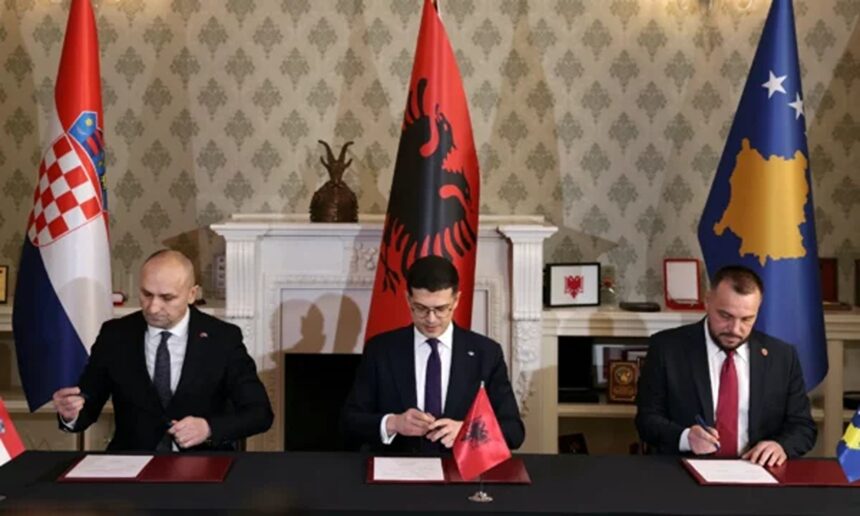
Former NATO spokesperson Jamie Shea has assessed that defense cooperation between Kosovo, Albania, and Croatia does not pose a threat to Serbia.
Shea, who served as NATO’s spokesperson during the Kosovo war, stated that such cooperation will focus more on areas like wildfire response, environmental threats, pandemics, and similar challenges.
“We should not view military forces solely in terms of fighting major wars, and I do not see this alliance as being hostile toward Belgrade in any way. I believe Belgrade should participate in this form of regional cooperation, as it would serve as a confidence-building measure. As for Serbia, it is spending more on its military than necessary, especially considering that no one is currently threatening it,” Shea said on KTV’s program Interaktiv.
A few days earlier, Serbian President Aleksandar Vučić had expressed concern over this cooperation agreement between Kosovo, Albania, and Croatia, claiming that an “attack on Serbia” was being prepared.
“The facts do not support Vučić’s perspective. Serbia is not under threat from anyone. It is in the process of joining the European Union, albeit slowly. It attracts significant investment from the United States and Europe and participates in NATO’s Partnership for Peace, even conducting joint exercises with NATO—although President Vučić does not often mention this publicly. Therefore, the idea that Serbia is like Ukraine, facing a major external threat, is simply not true,” Shea emphasized.
He added that the major wars in the region are over and identified the main challenge in the Western Balkans as “gray-zone conflicts” or hybrid warfare.
“In other words, not through the deployment of military forces along borders—which would be catastrophic—but through efforts to undermine governments via cyberattacks, propaganda, disinformation campaigns, and sometimes even the deployment of armed formations, such as in the Banjska incident, where paramilitary forces aimed to create tension, division, and societal fragmentation,” Shea concluded.