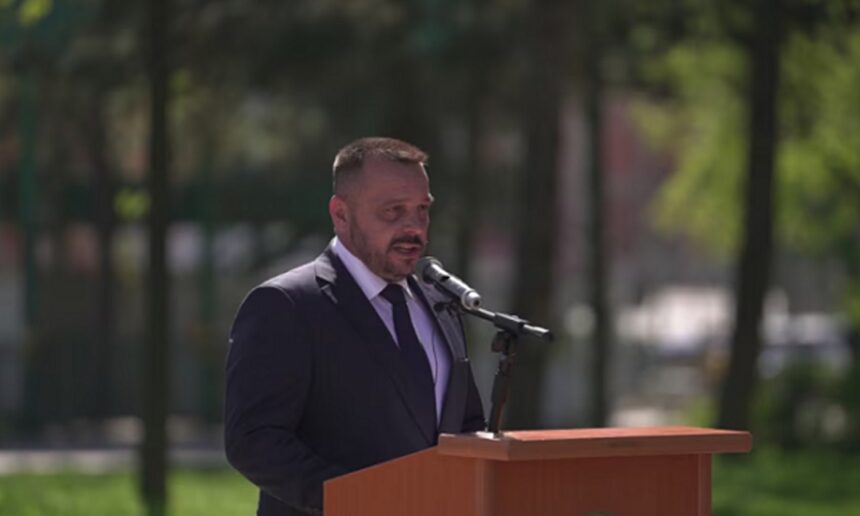
Kosovo’s Defense Minister, Ejup Maqedonci, told Radio Free Europe on Friday that Serbia’s claims of arming itself for protection against neighboring countries are unfounded. He said that with Serbia’s recent purchases of Chinese weapons, the country is instead revealing hegemonistic tendencies toward its neighbors.
Maqedonci made these remarks after Serbian President Aleksandar Vučić announced the day before that Serbia had acquired “destructive” Chinese missiles.
The weapons in question are supersonic CM-400 ballistic missiles from China.
“Purchases from Russia and China have been ongoing for several years and continue, so they are not related to any current threat to Serbia… No neighboring state has ever shown any aggressive or offensive intent toward Serbia,” Maqedonci stated, highlighting that Serbia itself has territorial claims toward Kosovo.
In an interview with Radio Television of Serbia, Vučić said that Serbia has successfully integrated the Chinese missiles into its existing Russian MiG-29 fighter jets.
“We have a significant number of missiles and will have even more,” Vučić said, without revealing the exact cost, though he added that the missiles “are extremely expensive. We got them at a small discount.”
Minister Maqedonci believes Serbia’s purchases from China reflect a continuation of Vučić’s policy.
“The Republic of Serbia mainly acquires military equipment from non-NATO countries. Strategic purchases have primarily come from Russia and China. From China, Serbia’s Ministry of Defense has procured FK-3, HQ-17, and HQ-9 air defense missile systems, as well as unmanned aerial vehicles and various radar systems,” Maqedonci explained.
According to data from the Stockholm International Peace Research Institute (SIPRI), between 2020–2024, Serbia imported the majority of its weapons from China (57%), followed by Russia (20%) and France (7.4%).
Croatian Prime Minister Andrej Plenković reacted to Serbia’s missile purchase, stating that the issue would be discussed with NATO.
Responding to Plenković, Vučić said, “Zagreb will not decide what Serbia will have.” He added that Serbia “is preparing for the possibility of an attack from the alliance being formed by Pristina, Tirana, and Zagreb.”
In March 2025, Croatia, Albania, and Kosovo signed a Declaration on cooperation in defense and security, which Serbian officials described as a threat to Serbia’s security.