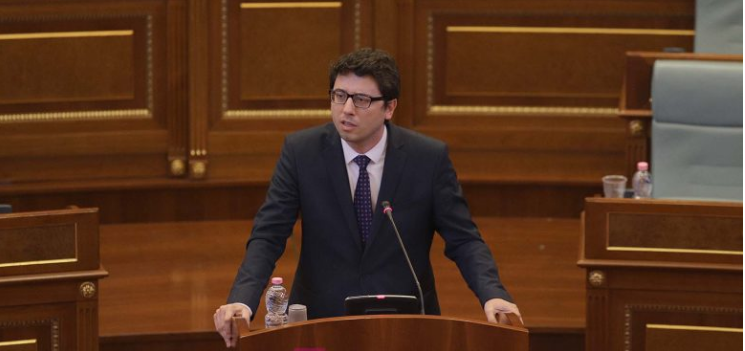
The Minister of Finance, Hekuran Murati, has presented a draft law aimed at introducing temporary measures to regulate prices of essential goods in cases of market instability.
Speaking on behalf of the Minister of Industry, Entrepreneurship and Trade, Murati said the proposal is designed as a state response to protect citizens from sharp price increases in basic products.
State intervention in exceptional circumstances
Murati stated that the draft law is intended to give institutions the legal tools to intervene when market prices rise beyond what he described as “economic logic,” placing direct pressure on household budgets.
He emphasized that the law is not a permanent interference in the free market, but rather an emergency mechanism to be activated only in extraordinary situations.
According to him, the objective is to establish a clear legal framework that allows temporary and proportionate measures to stabilize prices of essential goods.
Price controls and regulatory measures
The proposed legislation foresees a range of intervention tools, including the possibility of setting trade margins for wholesale and retail, as well as defining maximum prices for selected essential products during periods of crisis.
Murati stressed that the law aims to distinguish between legitimate profit-making and abusive pricing practices in times of instability.
He added that the state is not seeking to take control of the market, but rather to ensure a clear mandate for action when necessary to protect consumers.
Independent oversight mechanism
A key element of the proposal is the creation of an independent regulatory board tasked with overseeing temporary price measures.
The board would be established by the Assembly of Kosovo and would report directly to it, according to the minister, ensuring institutional oversight outside the executive branch.
Focus on essential goods
The law also provides for the categorization of essential products, including food staples such as bread, flour, milk, and cooking oil, with the possibility of further specification through secondary legislation.
Murati said the overall goal is to ensure that citizens are not left exposed to sudden price shocks affecting basic living costs.