When Kosovo began its qualifying campaign for the 2026 FIFA World Cup in September, the team had only one win in its short history of World Cup qualifiers. A heavy defeat to Switzerland in the opening match made many believe the national team was heading toward another disappointment.
However, in a remarkable turnaround over the following months, Kosovo achieved three victories and two draws, securing a place in the playoffs. The team is now just one step away from its first-ever World Cup appearance, coinciding with the tenth anniversary of Kosovo’s admission to FIFA.
Kosovo has never participated in a major tournament, and next summer’s World Cup in Canada, Mexico, and the United States could mark the country’s debut.
To reach the World Cup, Kosovo must first win two more playoff matches in March: a semifinal against Slovakia and a potential final against the winner of the Turkey-Romania encounter.
Sports analyst and University of Pristina professor Malsor Gjonbalaj described Kosovo’s potential qualification as “impressive, the best representation of the country on the international stage.”
“Football enjoys enormous popularity and global attention. Kosovo’s participation in an event like the World Cup would be the most significant recognition for our country,” Gjonbalaj, a former footballer, told Radio Free Europe.
How Kosovo Reached the Playoffs
After the opening loss to Switzerland in Basel, coach Franco Foda acknowledged that the team’s defense under the 4-3-3 formation had been weak and decided to change tactics.
“Although we had many duels, we lost the decisive ones, which affected the final result. Against Sweden, we must perform much better,” Foda said following the defeat.
Foda switched to a classic 4-4-2 formation for the next match against Sweden in Pristina three days later. Playing a more defensive game and relying on counterattacks, Kosovo scored twice and secured its first victory in Group B, 2-0.
After a goalless draw against Slovenia in the following home match, Kosovo won two more games against Sweden (1-0) and Slovenia (2-0), earning a playoff spot while adhering to Foda’s tactical approach.
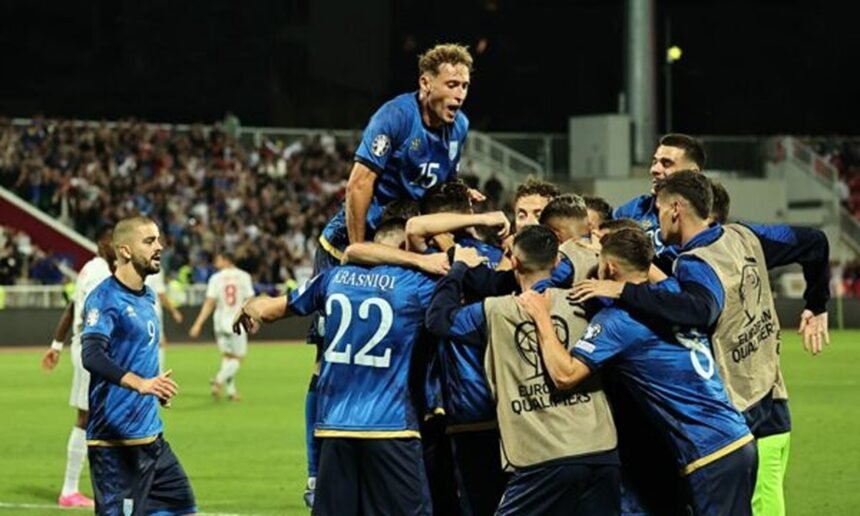
A 1-1 draw with Switzerland in the final group match in November brought Kosovo to 11 points, enough to finish second in the group and secure a playoff berth, while Switzerland qualified directly.
Gjonbalaj attributes Kosovo’s success to Foda’s disciplined, long-term approach.
“This is the result of consistent, long-term work. The coach implemented the tactical plan with discipline, selected the players carefully, and the team’s cohesion is the key factor behind these results,” he explained.
Since taking charge in 2024, Foda has reshaped the squad significantly, aided by the contributions of new players who have made a noticeable impact.
After Kosovo’s failed Euro 2020 playoff against North Macedonia, rebuilding the midfield was a challenge, especially following the departures of Hekuran Kryeziu and Herolind Shala.
The Football Federation brought in talented midfielders such as Elvis Rexhbeçaj in 2024, along with Leon Avdullahu and Veldin Hoxha ahead of the summer qualifiers. Rexhbeçaj (Augsburg) and Avdullahu (Hoffenheim) have been decisive alongside Florent Muslija, who has taken on a more attacking role.
Foda even positioned right-back Mërgim Vojvoda (Como) as a right midfielder, utilizing his technical skills effectively.
“Now we have midfielders who run, carry the workload, and show exceptional discipline, like Avdullahu, Rexhbeçaj, and Hoxha. They also contribute offensively with Muslija, who joins the attackers as a creative and technical player helping us reach the goal faster,” Gjonbalaj noted.
Foda’s tactics also meant leaving Kosovo’s top talent, Edon Zhegrovа, out of the starting lineup. Zhegrovа, who joined Juventus in the summer, is a winger primarily suited to a 4-3-3 formation.
Omitting Zhegrovа surprised many fans, but Foda’s strategy proved successful.
“We have many players; everyone deserves to play, but each must understand that representing the country can take just 30 seconds or a minute of action. No one should feel offended if they do not play,” Gjonbalaj explained.
It’s not only the midfield that has improved—attacking options like Fisnik Asllani (Hoffenheim) and defensive reinforcements such as Albian Hajdari and Dion Gallapeni have also impressed. Gallapeni, 19, may be Kosovo’s most sought-after addition, addressing a longstanding gap at left-back.
Gjonbalaj also highlighted that Kosovo benefited from weaker performances by other teams in Group B. Of the four teams, only Kosovo and Switzerland managed wins, while Sweden and Slovenia failed to secure victories.
Even with Sweden fielding two of the most expensive forwards in Premier League history—Alexander Isak (Liverpool) and Viktor Gyokeres (Arsenal)—they were unable to make an impact.
“There are no easy teams to beat, but it’s true that they were not at their best in these qualifiers,” Gjonbalaj said.
Sweden still reached the playoffs via the Nations League route, alongside Kosovo, and could ultimately participate in next summer’s World Cup.
Kosovo’s Playoff Prospects
Kosovo would prefer to play the playoffs immediately, given the team’s form, but must wait until the end of March. This delay means predictions are still tentative.
The Dardans will travel to Bratislava on March 26 for the playoff semifinal against Slovakia, a match they must win to keep World Cup hopes alive.
“Let’s not forget, we are excited to be in the playoffs, but the job isn’t finished yet. We need calm, professionalism, and hard work to secure qualification against two strong teams,” Gjonbalaj said.
If Kosovo reaches the final, it will be held in Pristina on March 31 against the winner of the Turkey-Romania match.
While Kosovo’s chances against Slovakia are strong, Gjonbalaj believes a potential final against Turkey would be much tougher.
“With Slovakia, we have a high chance, but in the final, Turkey would be a very difficult opponent. Still, playing at home gives us an opportunity,” he concluded.