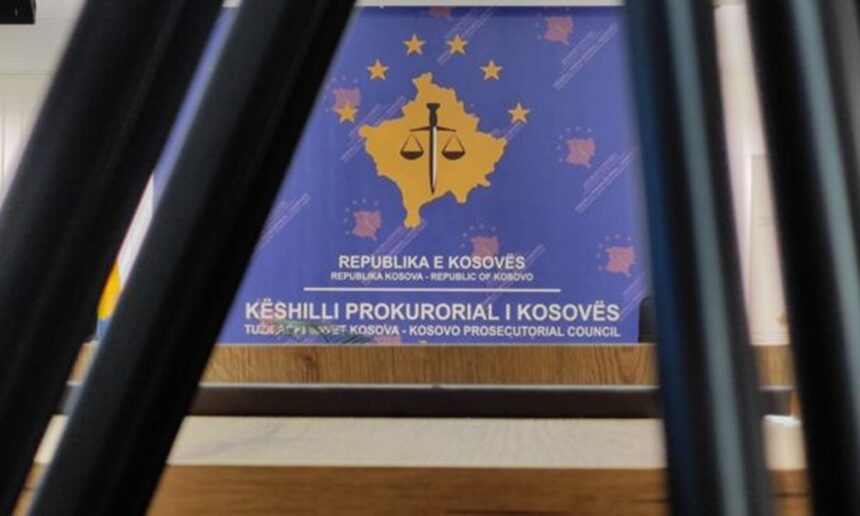
A group of candidates who were competing for positions as state prosecutors have requested that the Kosovo Prosecutorial Council (KPC) reconsider its decision to annul the competition and recruitment process for new state prosecutors.
At its 280th meeting held on 11 December 2025, the KPC decided to cancel the recruitment process for new prosecutors. This agenda item was discussed behind closed doors, without public access, reports Betimi për Drejtësi.
Following this decision, a group of candidates reacted by requesting a review of the decision and announced that they would take further steps, including potential actions related to criminal responsibility, arising from the annulment of the process.
Betimi për Drejtësi has obtained the formal request submitted by the candidates to KPC members on 26 December, in which they ask for an ex officio reconsideration of the KPC decision annulling the recruitment process.
In their submission, the candidates state that the request is based on a reasonable belief that the decision was adopted in violation of:
- the fundamental principles of administrative procedure,
- the Law on General Administrative Procedure (LGAP),
- the Law on the Prevention of Conflict of Interest in the Exercise of Public Office, and
- the very regulatory standards that the KPC is legally obliged to apply and protect.
According to the candidates, the decision fails to provide a clear factual and legal justification, creates ambiguity in the application of relevant legal provisions, and does not reflect a genuine proportionality analysis between the alleged public interest and the extreme measure of annulling the entire recruitment process.
They request that the KPC reconsider the decision, provide a detailed explanation of its factual and legal basis, and eliminate essential deficiencies in reasoning, thereby restoring standards of legality, transparency, and impartiality in a process of high public importance.
The submission emphasizes that if irregularities existed during the procedure—as claimed by the decision—they should be specifically identified and verifiably addressed, clearly determining:
- their nature,
- the procedural stage at which they occurred, and
- the institutional and individual responsibility for them,
so that appropriate measures can be taken against those responsible.
The candidates argue that the decision does not clarify which legal regime applies to the case—namely, whether the recruitment procedure or a specific administrative act undertaken within it was considered unlawful under Article 54 or lawful under Article 56 of the LGAP.
They further contend that the reference to Article 54(1)(1.2) of the LGAP, which claims that “the administrative object is legally or materially impossible,” is unsupported by the factual circumstances of the case and incorrect in legal interpretation. The decision, they note, does not identify any concrete action, phase, or obligation imposed during the recruitment procedure that would justify such a conclusion.
On the contrary, they stress that the recruitment process was materially possible, had already commenced, and had progressed to the interview stage of candidates.
As a result, the candidates conclude that reliance on Article 54 is unfounded, legally erroneous, and inappropriate to the circumstances of the case.
They also argue that the application of Article 56 of the LGAP was incorrect, stating that the complete annulment of the competition is not beneficial to all parties and instead produces serious negative consequences for candidates who invested substantial time and effort in professional preparation within a procedure that had reached an advanced stage.
According to the submission, the decision also fails to clarify whether the alleged irregularities were examined individually, or at which specific stages of the procedure they allegedly occurred.
The candidates invoke the principle of proportionality, arguing that institutional responses to procedural irregularities should aim at remedying deficiencies and assigning individual responsibility, rather than imposing collective punishment on all candidates for unspecified and non-individualized irregularities.
They further claim that the decision does not identify the specific procedural acts or actions alleged to be in violation of regulatory principles, nor the persons or structures responsible for them. If violations affecting the integrity of the recruitment process existed, the KPC should have clearly reflected its approach to addressing them, including identifying responsibility and outlining measures taken or planned to safeguard procedural integrity.
“A decision that declares the existence of ‘irregularities’ without explaining how they were established and without clarifying responsibility does not create transparency, but rather undermines it and makes legality review more difficult,” the submission states.
The candidates also argue that the decision does not clearly or fully present the factual situation on which it was based, does not identify or explain the evidence or information sources allegedly proving the irregularities, and does not reflect a concrete evaluation of such evidence by the Council.
They describe this conduct as particularly concerning given the role and mission of the KPC as a key institution within the justice system, which should serve as a model for legality, transparency, and accountability, rather than create practices that undermine trust in institutional processes and the principle of legal certainty.
Additionally, the candidates claim that the decision excludes the possibility of administrative and judicial remedies, which they argue is contrary to Article 13 of the LGAP. According to them, denying this right is not only unlawful but also violates constitutional principles of access to justice and effective legal protection.
The submission further notes that the decision was taken during a closed meeting, despite the absence of any legal basis for excluding the public. This, they argue, violates the principle of transparency and undermines public and stakeholder confidence in the Council’s decision-making.
The candidates also allege a conflict of interest, stating that one KPC member participated in the decision-making process even though his son had been a candidate in the competition and was disqualified at the qualifying test stage. Although the family member did not advance further in the process, the candidates argue that this circumstance objectively constitutes a conflict of interest, undermining the principle of impartiality and creating reasonable doubt about the objectivity of the decision.
Based on all of the above, the candidates conclude that the decision was adopted under circumstances that raise serious doubts regarding its legality, proportionality, impartiality, and reasoning.
They argue that the decision fails to meet minimum standards of legal reasoning, is characterized by incorrect application of legal provisions, disproportionate use of administrative discretion, and failure to address conflict-of-interest concerns—all of which directly affect its legality.
For these reasons, the candidates assert that strong legal grounds exist for the KPC to reconsider the decision and request that the issue be placed on the agenda of the Council’s next meeting on 29 December, in order to:
- provide a full, clear, and well-argued factual and legal justification, and
- consider either continuing the recruitment process or remedying it through individualized treatment of alleged irregularities and assignment of responsibility.
Finally, the candidates warn that if their concerns are not addressed, they will exhaust all legal remedies available under applicable legislation to protect their rights and legitimate interests.