

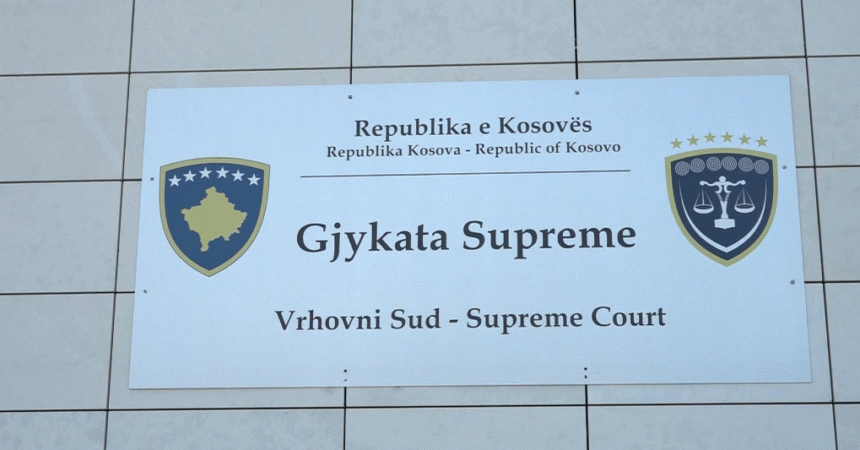
Kosovo’s Supreme Court has ruled entirely in favour of five plaintiffs who challenged the legality of a regulation adopted by the Central Election Commission (CEC) concerning changes to its internal organisational structure and the classification of job positions.
In its judgment, the Supreme Court declared Internal Regulation No. 01/2026 unlawful and annulled it in its entirety, including Annex I, which contains the organisational chart of the CEC Secretariat.
The lawsuit was filed by five individuals identified by the initials V.E., B.A., A.B.-B., V.K. and N.H., who challenged amendments to the commission’s Internal Regulation No. 07/2024 on Internal Organisation and Job Classification.
In reviewing the case, the court examined the legality of the job reclassification process, focusing particularly on compliance with objective criteria, the principle of equality and the obligation to provide clear reasoning for decisions affecting the legal rights of public officials.
The Supreme Court acknowledged that the CEC has the authority to reorganise its internal structure and revise job classifications. However, it stressed that such decisions must be supported by functional analyses, objective criteria and clear justifications explaining why certain positions are included in or excluded from the reclassification process.
According to the court, the CEC failed to provide a functional analysis justifying why only eight positions were selected for reclassification while the plaintiffs’ positions were excluded. It also found that the commission had not presented concrete reasons explaining differences in the nature of duties, levels of responsibility and competencies between the positions included in the process and those left out.
The court further noted that implementing the contested regulation had enabled changes to salary coefficients for employees occupying the eight reclassified positions, while the plaintiffs’ positions remained unchanged.
This resulted in different treatment without evidence of objective and reasonable grounds to justify the distinction, the court concluded.
Emphasising the principle of equality, the Supreme Court stated that individuals in identical or comparable circumstances must be treated equally unless differences in treatment are supported by clear, objective and verifiable criteria.
It also stressed that job classification must be based on the nature of the functions performed and the responsibilities attached to each position, rather than selective decisions lacking clear justification.
In its reasoning, the court also referred to its judgment P.A. No. 24/2026, issued on September 17, 2026, through which it had previously annulled Article 7 of Regulation No. 01/2026.
Given the inseparable connection between the remaining provisions and the annulled article, the court determined that the rest of the regulation had no independent normative content or legal effect that would allow it to remain applicable as a separate act.
Consequently, the Supreme Court extended the annulment to the entire regulation, including its annex, in order to preserve the coherence of Kosovo’s legal system and ensure legal certainty.