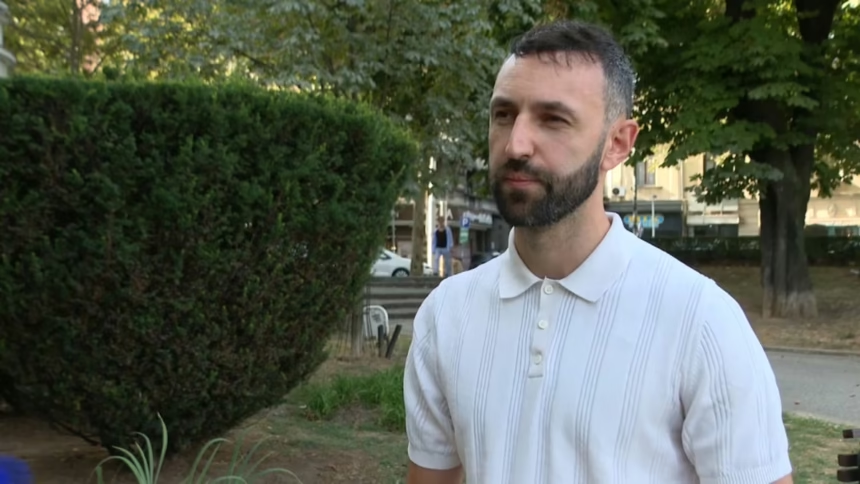
A spokesperson for the civic movement Kreni-Promeni, Nikola Stanković, has described recent remarks by Milenko Jovanov, a member of the presidency of the Serbian Progressive Party, as deeply troubling and politically dangerous, warning that such rhetoric risks normalizing violence against citizens.
The reaction came after Jovanov compared protests in Serbia with events in Iran, stating that “30,000 demonstrators were killed” there, while claiming that no demonstrators were killed in Serbia “thanks to President” Aleksandar Vučić.
In a statement, Kreni-Promeni stressed that “30,000 dead people is not an argument – it is mass bloodshed.” The movement argued that when authorities refer to scenarios in which tens of thousands of citizens could be killed and then present themselves as deserving credit for not doing so, the line of acceptable political discourse has already been crossed.
According to Stanković, in a normal democratic system, a government should never measure its success by the fact that it chose not to shoot at its own citizens, emphasizing that refraining from mass violence cannot be presented as a political achievement or personal merit of any leader.
He further warned that presenting restraint from mass violence as a success effectively normalizes the idea that shooting at citizens was a real option, something he described as extremely alarming in a democratic society.
Stanković also highlighted another part of Jovanov’s statement that he said raises concern — the suggestion that anyone in power could at some point lose composure and make decisions that lead to escalation. He argued that a state must never depend on the mood or self-control of individuals, but instead on institutions and systems designed to exclude the possibility of force being used against peaceful protesters.
The movement emphasized that people who have been protesting for months are not enemies of the state, but rather students, parents, workers, neighbors, and friends, adding that in a democratic society, authorities do not face adversaries in the streets, but citizens exercising their rights.
Kreni-Promeni concluded that a government that boasts about not shooting at its own people demonstrates how dangerously the boundaries of what is considered normal political discourse have shifted.